Families were usually the first to observe changes in their loved one’s responses and breathing patterns in the last few hours, or last few minutes, as they approached death. I explained there are only five observable ways to die. I call these ‘modes’ of dying.
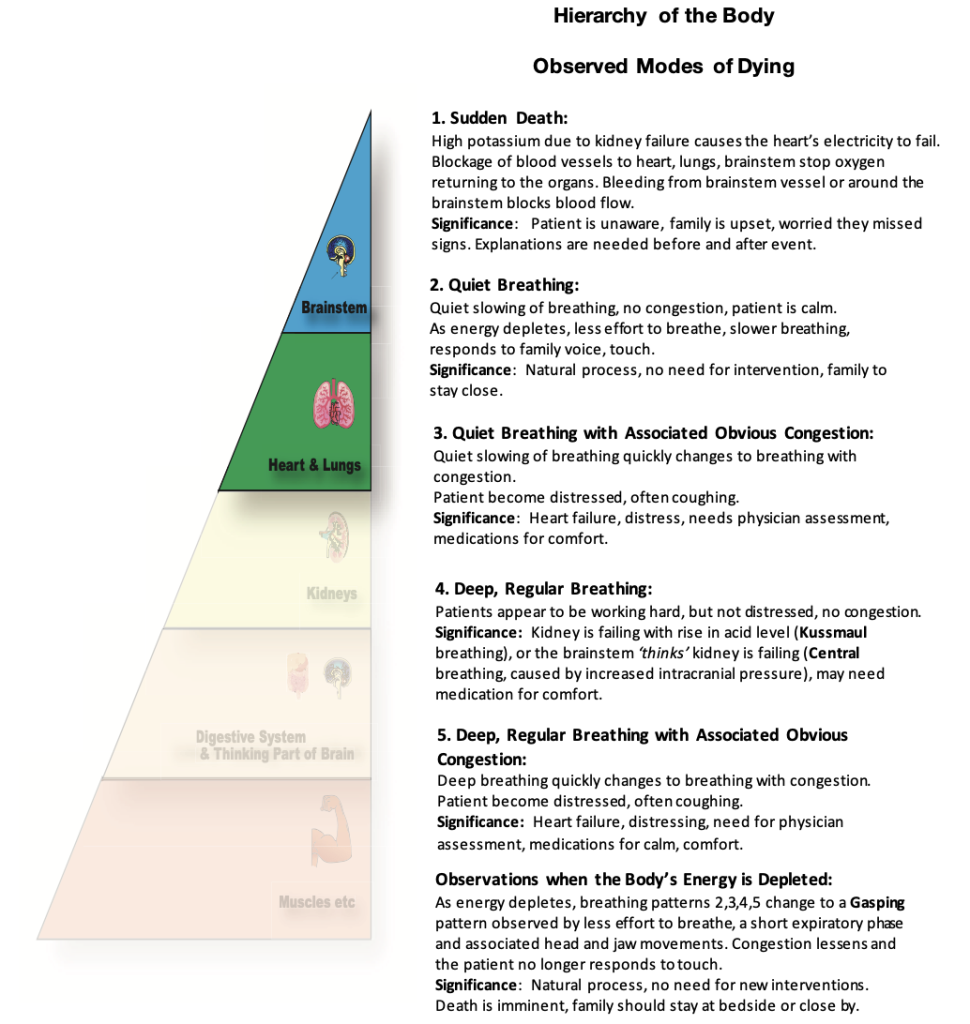
Knowing that families often observed the changes in breathing patterns, I tried to explain each pattern, their underlying cause and significance, before the events occurred. I explained that, as death approaches, there are five different patterns they may observe (i.e., sudden death, quiet breathing with or without congestion, and deep regular breathing with or without congestion).
The family observes that their loved one has been weakening but demonstrating no obvious life-threatening premonition. Suddenly, after a return from a trip to the bathroom, or just sitting up in bed, or comfortably sleeping in bed or in a chair, they stop breathing. If standing, they fall to the floor; if in bed or in a chair, the family member cannot awaken them. The patient does not appear distressed. The family is often shocked and distressed.
Significance of the Changes:
Acute failure of four vital organs can lead to sudden death:
Kidneys: If the kidneys cannot control the electrolytes, especially high potassium, the imbalance disrupts the heart’s electricity, causing a sudden cardiac arrest.
Heart: If there is blockage of blood flow to the central heart vessels there is cardiac failure and, suddenly, no blood flow to the brainstem.
Lungs: If there is a large blood clot within major lung vessels completely blocking the blood flow, suddenly, there is lung failure with no oxygen distribution to any part of the body, including to the brainstem.
Brainstem: If there is a large blood clot within the blood vessels to the brainstem or massive bleeding compressing the brainstem vessels, suddenly no oxygen flows to the brainstem.
Approach to Care:
There is no need for medical intervention for the patient, but there is a need to quickly assess the situation and carefully explain to the family what has happened. Even if I discussed the possibility of sudden death with the family before the event occurred, I needed to support them by explaining the event again after the death, reassuring them that they were not responsible. It is a very emotional time for the family. Even though we often say that we wish death to occur suddenly, when sudden death does happen it is a shock. Often the family feels guilty, wondering if they did something to hasten the death or feeling they should have predicted and managed the event better.
If the conversation about sudden death occurs for the first time after the event, the caregivers are often not reassured. They may state, “You are just trying to make me feel better. I just should have known.”
The family observes that breathing is becoming quieter, with less effort, and more time between respirations. This pattern becomes more prominent over a few hours. There are no signs of distress, their loved one is asleep, perhaps responding a little to the family’s voice or touch, sucking a little and swallowing with mouth care.
Significance of the Changes:
I explain to families these signs signify the final phase of the body’s natural path toward death with the brainstem in control and no vital organ suddenly failing. It is what most families would call “a good death.” In the following minutes to hours:
These observations signify that the brainstem is still in control, but the energy left in the muscles of breathing is almost depleted.
Approach to Care:
The patients are calm; high carbon dioxide causes loss of consciousness. Medication is rarely needed because there is no discomfort. The family can spend time quietly beside their loved one. The patient may not understand what is being said, but they feel the touch, sense the familiar voices, and are comforted by the family’s presence.
The family observes their loved one’s quiet breathing suddenly becomes more and more congested (i.e., secretions in their throat and lungs) and frequently with an associated cough. If the patient is awakened by the changes, they appear to be in severe distress. The family is justifiably worried and needs help to reestablish their loved one’s comfort.
Significance of the Changes:
I explain to families that these sudden new observations signify that the patient’s heart is beginning to fail:
These observations signify life-threatening and distressing situation. Energy is wasted with the restlessness, further decreasing oxygen saturations, and increasing the pulse.
Approach to Care:
This mode of dying requires regular medication to calm distress and dry the fluid in the lungs. Morphine combined with a tranquillizer is often used to alleviate restlessness. Scopolamine, with a drying effect and sedative properties, is administered to decrease the fluid in the lungs and help maintain comfort.
Once comfort and calmness are achieved the breathing changes back to the quiet breathing with or without some congestion. Still, the medications usually need to be given regularly to maintain control of these symptoms.
The family observes the beginning of deep, regular breathing. Sometimes, it returns to a normal pattern after minutes to hours, then the deep breathing restarts. Eventually, this pattern goes on and on, as if there were a machine initiating the breathing. The family does not notice congestion. They do not observe facial grimacing or restlessness. But they observe the obvious effort of breathing and often interpret their observations as, “They must be very uncomfortable because they are working so hard.”
Significance of the Changes:
I explain to the family that this breathing pattern is triggered by the brainstem sensing the acid is too high in the body, soon to cause a life-threatening situation. Two causes lead the brainstem to trigger this emergency breathing pattern:
The ongoing deep regular breathing signifies that the brainstem is using all its energy to try to maintain the balance of its internal environment. Both Kussmaul and Central breathing look the same to any observer. Unfortunately, this survival technique is so energy-depleting that it cannot be maintained for long.
Approach to care: This situation does not need any intervention except to explain what is happening to the family. If the patient is awake enough to feel some distress, or the family is convinced that their loved one is feeling distress, minor tranquillizers may be given as needed for comfort.
The family observes a frightening change in the pattern of deep, regular breathing. They begin to hear more and more congestion at the end of each breath, progressing to congestion throughout both inspiration and expiration. Their loved one continues to work hard, and now, they demonstrate facial grimacing, restlessness, and distress.
Significance of the Changes:
I explain to family that these sudden new observations signify the patient’s heart is beginning to fail. Their loved one, who was in kidney failure or had poor blood flow to the brainstem, is now in heart failure as well. These observations signify that the situation is life-threatening and distressing. Energy is wasted with restlessness, further decreasing oxygen saturations, and increasing the pulse.
Approach to care:
This mode of dying requires regular medication to calm distress and dry the fluid in the lungs. Morphine combined with a tranquillizer is often used to alleviate restlessness. Scopolamine, with a drying effect and sedative properties, is administered to decrease the fluid in the lungs and help maintain comfort.
Once comfort and calmness have been achieved the breathing then changes back to the deep regular pattern of breathing with or without some congestion. Still, the medications usually need to be given regularly to maintain control of the congestion.
Observations when the Body’s Energy is Almost Depleted
The family begins to observe a subtle change in breathing patterns 2, 3, 4, & 5. Within minutes to hours, the changes are more obvious. They observe less effort of inspiration and almost no effort of expiration. On inspiration, they see the patient’s head tilt upward with the lower jaw moving down. If there is congestion, it seems a little less. Their loved one appears comfortable, but no longer responds to any touch or voice. It is very difficult to measure pulse and oxygen saturation. This breathing pattern can best be described as a gasping pattern.
Significance of the Changes:
I explain to the family that the body’s energy is almost depleted. The brainstem initiates this final breathing pattern, a common last phase in all the modes of death except sudden death. The jaw and head movements are an attempt by the brainstem to help decrease the energy needs of the respiratory muscles by opening the tracheal passage a little more, thus allowing air to enter the lungs more easily. There is really no effort in expiration, rather gravity passively pushes down on the chest wall slowly pushing out the air from the lungs. If there was congestion, the noise decreases significantly because there is very little airflow in and out of the lungs. These are not efficient measures. They are signs that the brainstem is desperately trying to do all it can to extend the body’s survival.
Occasionally, the family observes a sudden ‘jolt’ after the breathing seems to have stopped for a few minutes. This is another reflex phenomenon triggered by the brainstem. The brainstem sensing no breathing action sends a desperate message to the heart and lungs to start functioning again. The heart and lungs try to restart and succeed for a few minutes, but there is no energy left in the body to sustain the activity. This pattern happens in patients who are known to be ‘fighters’. It may happen several times, each successive episode demonstrates less effort. It looks distressing. It is not. It is an automatic response, one or two last futile attempts to survive.
These resources (Chapters 18 – 21) explaining the science of near-end-of-life are based on my past scientific background augmented by my clinical experience gained through my community practice.
I presented the information as if I was explaining the process to each of my patients and families, reviewing the observations – both subjective and objective – explaining their significance, then planning together any changes to our approach to care based on our clinical evidence.
Understanding the observations as destabilization began, demonstrated by the different modes of death, was key for both the patients and families. Families were usually the first to observe these changes, indicating the timeline to death was very short with symptoms that could be very frightening. The patterns of sudden, deep breathing and any distressing congestion could easily lead families to panic and leave them with an emotional scar for years, feeling that their loved ones died in pain and distress.
When I explained these possible changes before they occurred, arranged for medications in the home ready for administration, and provided the family with 24/7 links to the nurses and physician, the family’s fears were at least partially dissipated. When we quickly achieved calm and comfort for their loved one, the family was back in control. When the family understood that the distressing patterns could recur and had the knowledge and the tools to reestablish balance, they could now spend their last hours quietly supporting their loved one.