Did my patients, families and I succeed in providing answers to the first two of three most frequently questions asked by patients and families about their journey towards death: “How long do I have to live?” and “What will the process of dying look like and feel like?” I believe that we did respond to these two questions. The realization that the ‘answers’ were not straightforward and unique with each patient’s journey brought significant insights. This chapter consolidates the ideas needed to reaffirm a response to the first two questions and illustrates the complexity of the answer to the third question, “We have asked these questions about death and dying before, why did no one give us an answer?”
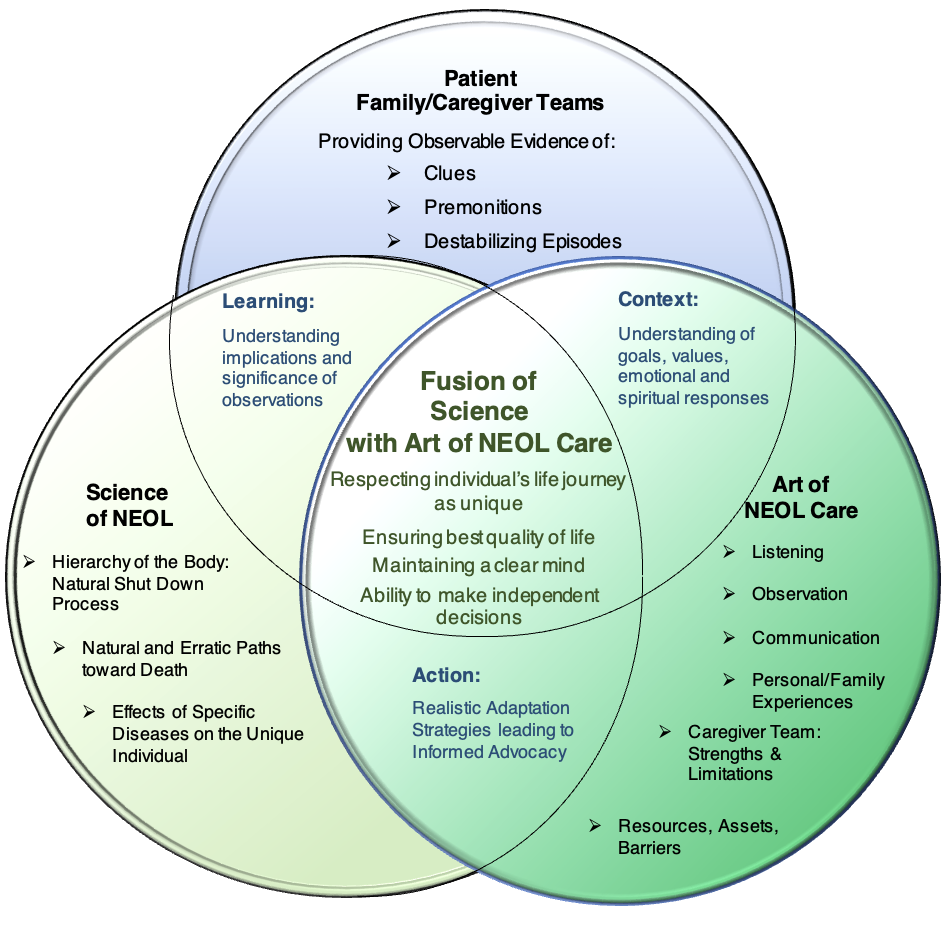
reviewing, consolidating, and synthesizing the Lessons Learned at the end of Chapters 1 – 16, my role and the role of the patients and families/caregivers became fully transparent, demonstrating how these roles were interrelated and reciprocal in supporting near-end-of-life care. (Refer to the Venn diagrams on subsequent pages as a visual representation of the big ideas.) The Venn diagrams, with the intersection of two or three circles, show the power of merging observational and objective clinical data with experience to find the best solutions for near-end-of-life care.
A Venn diagram is an illustration that shows logical relations between two or more groups of ideas, data etc.
Venn diagrams use overlapping circles to show how given items are similar and different.
As a physician, I consistently taught each patient and their caregiver team the science of the body’s functioning at near-end-of-life including:
The patients, families and caregiver teams provided observable evidence of:
These were merged with the tools provided by the science of Near End of Life (NEOL):
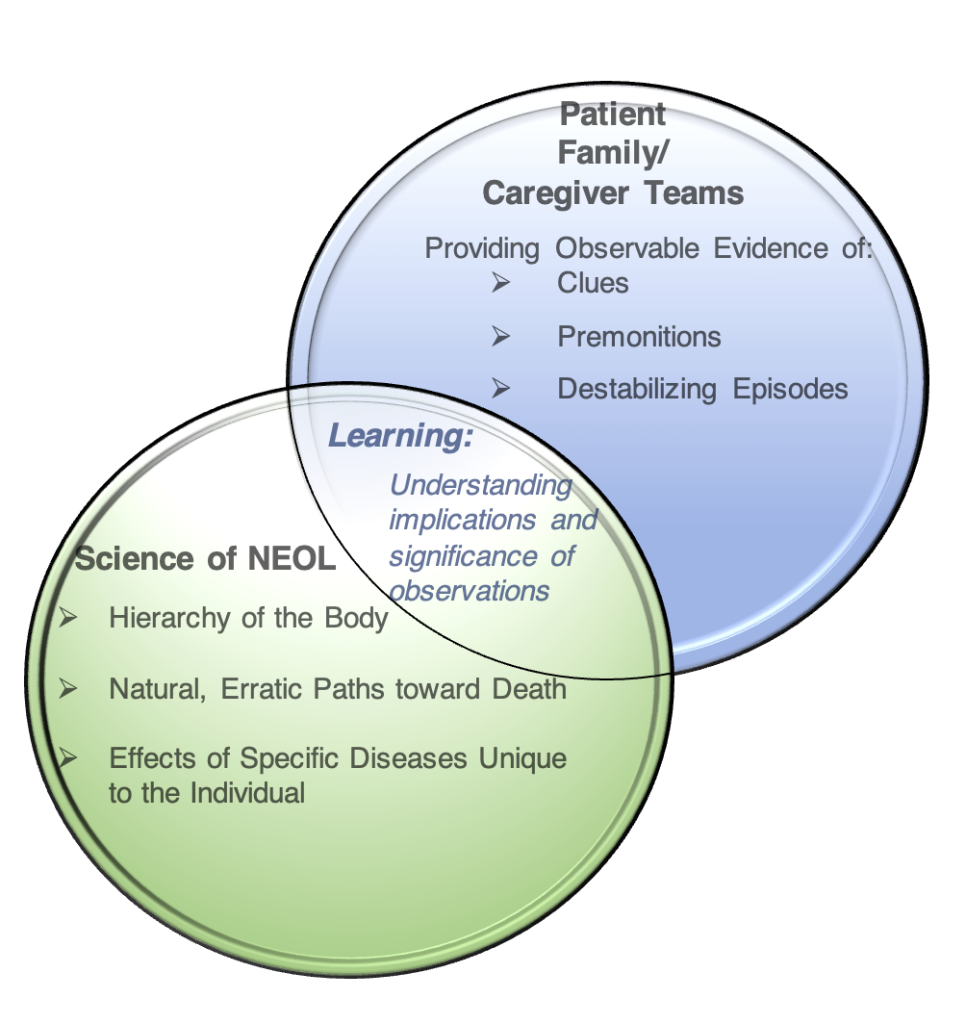
Together we learned to understand the implications and significance of these key observations in the body’s paths toward death.
Growing in mutual understanding, together we intertwined the Art of Near-End-of-Life care including:
These processes resulted in realistic adaptations for the patient and informed advocacy to achieve the patient’s and family’s important goals.
The Fusion of the Science with the Art of Near-End-of-Life Care creates a unique journey at near-end-of-life, ensuring the best quality of life possible, allowing the patient to maintain a clear mind and the ability to make important decisions independently within the reality of their personal context.
The third question asked by patients and families was more complex to address. Patients stated, “We have asked these questions about death and dying before, why did no one give us an answer? Most physicians either did not try to answer that question or merely stated that no one could predict the timing.”
Although very frustrating, the physicians who did not respond were being truthful. No one can predict exactly when someone will die. But if the patients and families are given the tools of the science of near-end-of-life care and are coached to incorporate the art of near-end-of-life care throughout the journey, they are the ones who have the greatest knowledge and can make the most accurate predictions.
After twenty-four years caring for patients at near end of life, as I was reviewing my patients’ data, I had my own revelation about the body’s path toward death. I realized that the explanations make much more sense if we consider that the body has two primary paths towards death:
The natural path toward death is controlled by the brainstem following a predictable sequential shutting down process as I had illustrated on my Hierarchy of the Body card.
The erratic path toward death is unpredictable, occurring when the brainstem is suddenly assaulted with episodes bringing the body to the edge of death, followed by recovery back to a non-life-threatening functional level. Episodes repeat themselves over and over until the assault is so extensive that recovery is not possible. It is the erratic path towards death, triggered by the assaults on the heart, lungs, and brainstem, that prevent specialists from answering the first two questions. The key to answering all the questions is to involve the families, realizing that they are the experts of their loved ones when they are given the knowledge of the process and the significance of the changes.
In writing this journal, I wished to disseminate the gift my patients and families gave to me when they allowed me to be part of their journeys. My ultimate lesson came from an understanding that the success of their journey did not hinge on me, the various physicians, the other caregivers, nor the resources (although each part was important)! Success came from the experts (i.e., the patients, and families/caregivers) who, knowing the significance of what they were observing, found unique ways to advocate, adapted to changing circumstances and achieved the best quality of life for their loved one.
Making Connections through Personal and Family Experiences
Allow me to make connections to this notion of the fusion of the science and art of near-end-of life care by sharing one final story to demonstrate how I incorporated these lessons, learned from my patients, to help care for my own family. I will relate this story, not from the point of view of a physician, but from the perspective of a family member trying to help a dearly loved sister, Nicole, through her near-end-of-life journey. I hope this story will be a testament to the values she held dear throughout her life as a sister, teacher, friend, wife, mother-in-law, mother, and grandmother. While reading this detailed story make your own connections by recalling the near-end-of-life of loved ones, both the similarities and differences in the journeys.
Nicole’s Journey
In the first chapter of the journal, I explained that my family was an army family, moving about Canada to a different province every few years. My sister, Nicole was the eldest, followed by my only brother, Pierre, my sister Michelle, each a year apart in age. I was five years younger than Nicole and Hélène was ten years younger.
We were a nuclear family having close stable contacts only with our siblings and our parents until my father retired from the army and we settled in Ottawa during the high school years of the four oldest children. Nicole and I were always in different schools, and in the summer, Nicole visited my grandmother and our cousins in the Quebec City area, being the only sibling who had memories of our extended family. Our lives were busy, and we did not interact closely. Our communication skills were not great. Over the years we demonstrated our caring for each other mostly by actions, not with words.
I realized very early that Nicole and I did not think the same way. I knew that neither way was wrong, or better than the other, just different, but it did make communication more difficult. Nicole had a very linear way of thinking. When faced with a problem, she decided her goals early in the process and found ways to achieve that goal expecting success, often ignoring there might be other solutions or obstacles along the way. I often took a 360º approach. I would look at all the possibilities for success and all the potential barriers for failure. I would anticipate the barriers, set up strategies for each, and only then dare to move towards action.
In times of crises our differences in thinking became obvious. If I tried to explain my concerns about possible medical problems, proposing various alternatives, Nicole resisted telling me very clearly, “You are too pushy” and communication immediately ceased. I would go back to my observer and listening mode – a very comfortable place for me.
Although we were far from a ‘perfect family’ (Is any family ever perfect?), we continued to grow and demonstrate our love and respect for each other. Nicole became teacher at the primary level. She loved the interactions with the children and her colleagues. She never wavered in her career. Nicole had a deep spirituality, that also never wavered. When she married, she demonstrated her love and respect for me by asking me to be her bridesmaid.
After Nicole married, her focus shifted, centering on her new family, her husband, children and her husband’s mother who was generous with her time in helping to care for her grandchildren. Juggling family priorities with three young children and her teaching career was hectic but she made it work! Her children were young when our mother, grandmother and father died so she could not be involved in their day-to-day care. After the deaths, we essentially kept our thoughts and feelings within ourselves and continued with our busy lives.
When Nicole’s husband was diagnosed with cancer, she decided to care for him at home and was successful. Nicole needed to find more time to achieve this goal while continuing to care for her children who were in their late teens and early adult lives. She decided to retire and devote all her time to her family. I realized that, although she had been in the background during our parent’s deaths, she had learned a great deal about the death and dying process and used her knowledge to obtain the help she needed to care for her husband a home.
After her husband died two years later Nicole took care of his mother, who had lived with them since their children were young and had helped care for them while Nicole taught her students. Nicole never had second thoughts! She had promised her husband. She had to repay his mother for her help and although it was not easy, Nicole continued with her care for seven years. Nicole never complained. She succeeded, and her mother-in-law died quietly in Nicole’s home with just a little help and support from our family.
After her mother-in-law died, Nicole downsized to a condo. Her motivation now expanded, from caring for her children, to include the care of her grandchildren. She was going to do everything she could be with them all, loving them and caring for them as best she could with her physical limitations.
I observed her through all these steps in her life. I admired her ability to live her life as she saw it. One day, months after her husband died, she asked me to give a teaching session about the dying process at a long-term care facility where she volunteered.
I agreed and asked her if she wanted to be present with me to answer questions from the audience about insights she had gained through her journey with her husband. She beamed – she would be a teacher again! (That is one of the reasons I am using Nicole’s journey in this journal – I think she would be pleased to be a teacher yet again!)
The Fusion of the Science with the Art of Near-of-Life Care
During Nicole’s near-end-of-life journey, we never spoke about the science of the body’s shutting down process. I knew, intuitively, with previous experiences in our family, that she understood the process and if she had any questions, she would ask me.
Over the years after her husband died, Nicole rarely asked me to help her with medical problems. She was well set up with a family physician and numerous specialists, but occasionally she would ask me to explain the results of a test, or a treatment possibility offered by her specialist. She wanted to understand, to better decide on her own. If I crossed the line and offered any suggestions not already proposed by her own doctors or pointed out the possible negative effects, she would immediately point out, “You are being too pushy!”
But when she had a sudden medical complication, Nicole would contact me and ask for advice trusting that I would always be available to help. This approach to crises was frustrating for me. During a crisis was not the time to discuss our approaches – it was a time to act. After the resolution of a crisis, from Nicole’s perception, she was better, the problem was solved, and so no explanation of the science of the underlying causes was necessary. As she reached her near-end-of-life, I knew her approach would not change – she would have no reserve energy to do so. It would be up to our family to support her and adapt to her new circumstances.
The Science of Nicole’s Illnesses:
If Nicole had been one of my patients, I would have placed her in a category of ‘very complex disease interactions, making the approach to her care extremely challenging’.
Nicole had three severe, potentially life-threatening illnesses:
Severe rheumatoid arthritis: The arthritis affected all her peripheral joints interfering with her ability to raise her arms, causing difficulty walking from deformed knee joints and resulting in intermittent low back pain from deformities of her vertebral column. This disease was not likely to be life-threatening as it progressed, but it would interfere more and more with her quality of life, her independent living, and activities with her grandchildren.
She was prepared to undertake any corrective surgery to ambulate better. Her rheumatologist often remarked that, soon, if she wanted to keep walking, she would need bilateral knee replacements.
Vertigo: Nine years before her death Nicole suffered a severe vertigo (i.e., dizziness) episode. Investigations revealed a small tumour within her right inner ear. She was told that, likely, it was not cancer, but if it grew, because of its location, it could push into her brainstem and become life-threatening. It was too dangerous to remove until there were more acute symptoms and, even then, surgery would likely be impossible. The specialist followed her with an MRI yearly for five years with no changes. He then sent her back to her family physician to return if she had new symptoms.
Heart problems: Nicole was followed by cardiologists starting in her thirties due to uncontrolled hypertension. Although her blood pressure did regulate with medications, the cardiologist continued to follow her because she had an associated heart murmur. A CT scan revealed calcification and narrowing of her aortic valve. Occasionally she would tell me about its evolution, mainly to reassure me that it was not a significant problem, yet.
“Sometimes you must be pushy!”
About a year after the death of her mother-in-law, Nicole’s children planned a trip to Rome, Italy, where her youngest daughter was conducting research for a university program. Observing her increasing difficulty with walking and arm weakness from her arthritis, I worried about a crisis in the airports and while visiting tourist sites. Nicole was adamant that she would make the trip to be with her children.
We resorted to my father’s thinking and found the ‘elegant’ solution. My brother and a niece agreed to travel with Nicole to and from Rome. I ordered a wheelchair for Nicole to use for the trip and long walks in Rome to preserve her energy. She initially refused, stating she would be perfectly fine, but my brother was ‘pushier’ than I was stating he would not take the responsibility to travel with her without the wheelchair. Nicole had a wonderful trip! She enjoyed the privileges and kindnesses she received in the airports when she used the wheelchair – taken to the front of each line and helped with her luggage. Then, in Rome, visiting the Vatican in a wheelchair, she was placed in the front of the crowd and received a special one-to-one blessing from the pope! She would later remark how that moment was a highlight of her life!
Premonition:
During one of our regular family reunions, Nicole placed a small note in front of me, with the words severe aortic stenosis, and stated, “My cardiologist told me you would know what this means.” I did understand – Nicole to have her aortic valve replaced.
I also knew, from my medical experience, this was the beginning of Nicole’s near-end-of-life, but she did not grasp the long-term significance. Dying was the furthest thought from her mind. Her focus was to have her aortic valve replaced, recover, do her best through the rehabilitation program, continue physiotherapy, and live independently, now better able to be a grandmother to her present and future grandchildren.
I explained to Nicole and her family that the operation to replace an aortic valve was very serious and frequently life-threatening. Nicole focussed completely on the positive outcomes. She would fight and she would succeed. She asked me to be the family member available in the waiting room during the operation. When the surgeon came to review the operation, he knew I was a physician and talked to me as he would to a colleague, stating, “We used a tissue replacement valve because of the extensive damage around the perimeter of the valve. It should be functional for about 5 years.” He added quietly, “We did the best we could.” As a physician, I knew he was worried.
Nicole had two major complications from her surgery, a seizure soon after the operation and transient signs of a minor stroke the next morning, both clearing quickly. Then her recovery went well. Nicole had no recollection of these problems, she focused on her daily physiotherapist assisted walks while in the hospital and when she was discharged to a rehabilitation unit for one week.
No member of the attending team had asked about Nicole’s living arrangements. Therefore, no one knew that she lived alone and would not be able to follow up with appointments independently. Our family planned before the operation. We arranged for her to stay at my home with help from family members and a daily private nurse. The plan worked beautifully. Nicole had no complications and felt well enough to return to her apartment within the first week. She managed very well in her home, allowing a family member to drive her to all her medical appointments. And she continued to do well for more than four years. She felt so well that she agreed to undergo total knee replacements for both her knees, recovering independently of my help by being admitted to a retirement home for a week after each operation. She was able to do her own grocery shopping, drive to her medical appointments, and drive her car to visit her daughter and granddaughter out of town several times a year. She interacted with her grandchildren doing quiet activities and participated in family events.
Episodes:
On Nicole’s birthday, on a very hot and humid September day, just over four months before she died, I observed an episode. We had planned a small birthday celebration in my backyard on a Sunday afternoon. Once Nicole arrived, she sat in a chair throughout the afternoon, interacted at times, but mainly just sat and watched. She ate very little, but denied she was unwell. When she decided to leave, I could see she was having difficulty walking up a small slope to the driveway.
As a way to quietly assess Nicole’s functional ability, I attended a regular Sunday church service with Nicole. The Sunday of her birthday, I watched as Nicole struggled to reach the top of the church stairs. She looked at me, obviously short of breath, and said, “I don’t feel well.” I slowly walked her a few steps to our usual seat allowing her to rest and recover. Nicole stayed through the service with her breathing settled. After the service she slowly managed to descend the stairs and drove herself home refusing my offer to help by driving her home. I followed behind her, but, fortunately, she did not need me.
Nicole called me late in the evening a day later. She sounded desperate, asking me to please come over – she had terrible back pain. When my younger sister and I arrived, Nicole was in bed, mentally clear, but distressed with pain, not knowing how to transfer out of bed. She explained that once she had arrived home from church the evening before, she was feeling better and decided to tidy her living room. As she leaned over to pick an object from the floor, she had sudden severe vertigo which caused her to literally fly across the room, falling into a space between her sofa and recliner. She was able to get up, was a little sore, but seemed ok with no further vertigo. She was pain free during the day but this evening as she transferred to bed, she felt a sudden severe shooting pain in her lower back. At rest she was comfortable but with any movement the searing pain returned. She could not transfer to the bathroom. She did not know what to do.
We had two choices. I could call 911 and Nicole would be transferred to the emergency room. Or I could try to settle her pain with the medications she had at home for her arthritis, helping her to the bathroom and back to bed, and then stay overnight to repeat the process if needed. In the light of day, we could contact her family physician and at least have an assessment to decide if a trip to the emergency room was necessary.
From my knowledge of the science of near-end-of-life I knew the real problem we were facing was not the pain crisis but the underlying cause of her episode over the last few days – her ‘unwellness’ at the party and at church and the vertigo episode. I hoped that if we could partially control her pain, and set up an assessment with her family physician, we could advocate to control the pain, but also investigate this underlying problem.
In the morning with a regular regime of her own pain medications Nicole was able to transfer with minimal help. She called her family physician and set up an appointment with the nurse practitioner for the afternoon. The nurse practitioner, after her assessment, asked us to go to the emergency room for X-rays of her back and advised her family physician to send a referral to the specialist to re-evaluate her inner ear tumour. (Successful advocacy!)
In the Emergency Room in the evening, the staff assessed Nicole’s pain, controlled it with Morphine tablets, then prepared to discharge her home but relented, observing her limitations and fatigue. They decided to allow her to rest in the Emergency room until the morning. On discharge she was given a prescription of Morphine for a few days to reduce the intensity of the pain on transfers. From her family physician, she had an appointment with her ear specialist scheduled in six weeks.
In the afternoon of Nicole’s return home, a tornado swept through Ottawa, essentially less than a mile from our homes, cutting out the power to the entire area for days. We now had to be more involved in Nicole’s care, shopping and bringing meals to her. I stayed at night, my sister during the morning – we were together at mealtime.
Over that week, Nicole’s pain improved, she was able to transfer independently. She ate the meals we had prepared, but we noticed that she did not prepare simple meals herself. When asked, she stated, “Oh, I am not really hungry”, or “I was too tired to get up to the kitchen.” When the power returned, and Nicole’s pain improved significantly, we went back to our observer mode. Nicole continued to improve over the next month, but whenever we visited to have meals together, we noticed that she always looked very tired, no longer doing her daily walking, her dishes were often in disarray, and in looking into the refrigerator, we observed that there was NO food. She did admit during one meal, with pleasure, that she had lost about twenty pounds. All her life Nicole had great difficulty losing weight. My sister and I knew her weight loss was a very ominous sign.
From my perspective, as a sibling, I knew that Nicole was progressing and fragile and that she could destabilize at any time.
But I did not know which illness was the underlying cause of these changes.
Her rheumatoid arthritis with the sudden back pain brought her to medical attention. Now, with the pain medications during the acute phase and her usual medications for chronic pain, she was much more comfortable.
I observed periods of shortness of breath with activity. Was her aortic valve no longer functioning well? But her pulse and oxygen saturation were normal.
I observed periods when her thinking changed, she drifted away, then came back. Did these clues have something to do with the tumor in her inner ear growing into her brainstem? During this time frame, she did have a head CT scan of her head. I was told that something had changed, and the specialist suggested an appointment with another doctor, but it was scheduled for a few months later.
Destabilization Episode: Still in an Active Mode
Six weeks before her death, Nicole started to show signs of destabilization. In the morning with just a little activity she became very short of breath with her pulse increasing and her oxygen saturation decreasing to the low 90s. She settled at rest. Nicole’s breathlessness increased, until one day she admitted to the changes and asked me to take her to the emergency room. She hoped to be admitted to the hospital this time and transferred to the Heart Institute so her aortic valve could be replaced. She was certain she would then be well again. Nicole wanted me to be present to explain her problems to the nurses and doctors; she was too tired to do so.
My younger sister and I brought Nicole to the emergency room. With the effort, she was moderately short of breath when we arrived and looked in distress. This time she was admitted to a general ward and within four days transferred to the Heart Institute. Investigations and assessments indicated severe damage to both her aortic and mitral valve causing several life-threatening complications, heart failure and a generalized infection, that needed to be resolved in preparation for cardiac surgery. As was the routine for patients awaiting cardiac surgery, she had daily physiotherapy, consisting of short walks along the hospital corridor with the help of a physiotherapist to maintain physical strength.
Advocacy, Family Support:
I became Nicole’s primary advocate. I explained to each of the nurses and physicians her story, including the vertigo episode that had happened on the day of the initial crisis. I explained to the family what was happening on each day so that each of us, when at her bedside could participate in the advocacy role.
I remained with her at night for support throughout her stay at both hospitals because of episodes of confusion at night. I observed the first episode the night of her admission during the transfer to her room around midnight. She suddenly sat up, looked at me saying, “Ok, I am going home now. Where are my clothes?” I gently asked her to lay back down, I explained the situation and reassured her that I would stay with her through the night. Through all the nights, when she awakened, confused, she would recognize me and settle without the need for medications.
From these episodes, I knew the tumour in her inner ear had extended to her brain and was causing the typical cyclical increase in her intracranial pressure, a pattern repeating over and over. During the day she was lucid and could understand directions and issues at a limited level. Then, each night she became confused, restless, trying to get up and go home. As a family, we set up a rotation and updated each other so that family members were at her bedside 24/7 to listen and advocate for her whenever a physician visited. We continued to mention to medical staff that Nicole had a tumour in her right ear that had progressed prior to her admission. We convinced one of the residents to order a head CT scan. It proved to be significantly abnormal.
Over two weeks at the Heart Institute, Nicole stabilized and improved. The cardiac surgeons were ready to operate. They explained to Nicole that the operation would be more extensive than they had predicted, involving both her aortic and mitral valve. She agreed to the surgery and the surgeons set a date for four days later.
Nicole felt that she had succeeded. She believed she would feel so much better after the operation. She set up a schedule to speak to her children, each one separately, one day apart. Daily, she would concentrate on the physiotherapy walk to maintain her strength. We, the family, observed, that despite her improved breathing and no fever, these walks were becoming more and more difficult and tiring for her.
The morning after the decision to operate was made, my younger sister was observing Nicole during her walk and as she rested in a chair midway. A surgeon, unknown to her, walked up and stated there had been a cancellation and her surgery was moved forward to the next day. These changes did not sit well with Nicole. She had a plan in place, had very little energy to adapt to any changes and she needed to talk to her children in the next few days. She felt this change was not for her benefit, only expedient for the surgeons and that she was being pushed to make a critical decision when all she could do now was focus on how to stand up from her chair with the help of two attendants. And that anger of being pushed combined with the fear of a difficult operation suddenly reminded her of the three previous major operations she had undergone in the last five years. She remembered how much effort it had taken to recover. She looked at the surgeon and told him, “I cannot go through with this operation. I am so tired now before the operation and I know it will be worse after. I could not possibly do the physiotherapy needed to recover.”
When I returned to the hospital, Nicole was resting in her bed and simply told me that she was not going through with the operation. Now she needed to have the meetings with her children to explain her decision. I quietly slipped into my doctor mode, stating, “Ok, why don’t you take time for quiet reflection, get some rest, and we will contact your children. We will not talk to the attending staff about the operation until you are sure of your decision.” She did not change her mind after speaking to her children. She asked for a referral to palliative care and trusted me to make the necessary arrangements.” I had already made tentative inquiries about palliative care, just in case the operation was not possible, or if recovery was complicated. The attending team simply contacted a physician on the hospital palliative care team to assess my sister and refer her for residential hospice care. I asked a palliative care physician colleague to take responsibility for her palliative care.
The Fusion of the Science with the Art of Near-of-Life Care:
Within two days, Nicole was transferred to the community residential hospice in accordance with her elegant solution. She did not wish to be a burden to her family, she needed 24/7 experienced personal and symptom control care, and the space to bring in her children with the grandchildren to visit her in a safe and friendly environment.
It was clearly evident now that Nicole was dying of increased pressure in her brainstem from the growth extending from her inner ear. The cardiologists had done a great job in stabilizing her other problems. Nicole no longer had shortness of breath at rest, infection was no longer a problem, and her heart functioned well enough for her survival needs while lying in bed. She did not have back pain at rest or with personal care. During the day, she was awake and lucid enough to eat small meals, interact with her children and grandchildren. Our family made the environment as homelike as possible. She was admitted just before Christmas. My younger sister and I brought parts of our Christmas village, with all the lights, and set them up in an alcove in her room. It was beautiful and everyone who visited stayed in the room a little longer, interacting with Nicole. My younger sister set up personalized books for each grandchild, brought them to Nicole. When the grandchildren visit, Nicole was able to give to each grandchild and read it with them. Nicole’s eldest daughter from out of town stayed in Ottawa, my sister from Calgary visited for a week, and my brother visited at some meals to help her eat.
After Nicole settled into the hospice routine, she told me, “I am very comfortable now, you do not need to stay at night.” So, I went home and returned the next morning. On my return, she looked at me pleading, “Where were you last night, I woke up and did not see you. Why did you abandon me?”
So, I returned to my usual role at nights. Intuitively, I knew what Nicole was saying to me. First, with the high pressure in her brain at night, she was confused and afraid – she needed a familiar presence at night. Second, she wanted to have her children around her when she died. The increased pressure in her brain was likely to cause the ominous complications in the early morning hours, so my last task, for her, was to stay each night beside her, to observe for the signs of imminent death and notify her children in time, so they could come.
And we were successful. The day before Nicole’s death, my younger sister noticed early in the morning while Nicole was still sleeping that her breathing was deep, regular, and her lips were blue. When Nicole awakened, she regained her alertness, ordering her breakfast. It was a brief, but ominous sign of imminent death. Before dawn the next day, I awakened as the nurses arrived a few hours after midnight to reposition her. We all heard the deep regular breathing and the congestion in her lungs. We knew her brain was pushing into her brainstem and her heart was failing. The nurse administered Scopolamine to control the secretions and she settled. By mid-morning, her three children were beside her. Nicole remained very peaceful and died quietly by the afternoon with her children beside her.
Making Connections:
Nicole’s journey, along with many of the journeys I previously outlined in this journal, described an example where the need for near-end-of-life care did not commence and follow a timeline that fit rigid palliative care guidelines (i.e., a projected three-month prognosis prior to death). Nicole took an erratic path toward death, triggered by a small tumour growing into the area about her brainstem. Our family noticed the changes first. Initially, these changes were subtle, but as they became more significant, they started to recur and became more evident. Each family member needed to understand what was happening. We advocated for Nicole, investigated resources that might soon be needed, continued to observe, and accessed help when premonition signs became evident. We allowed Nicole, with lucid periods in the day, despite confusion at night, to make her own decisions through her unique near-end-of-life care. Nicole succeeded to live until her death her way.
Rest in peace, beloved sister, wife, mother, grandmother!