
When patients and families wished to ask me questions about their future journey as they approached death, and stated they wanted to be a central part of the decision-making, I explained my thinking. They needed to understand what findings I assessed at each visit and the significance I assigned to each of the changes. The first step in the process was to explain the base of the science of the body’s functions for survival at near-end-of-life.
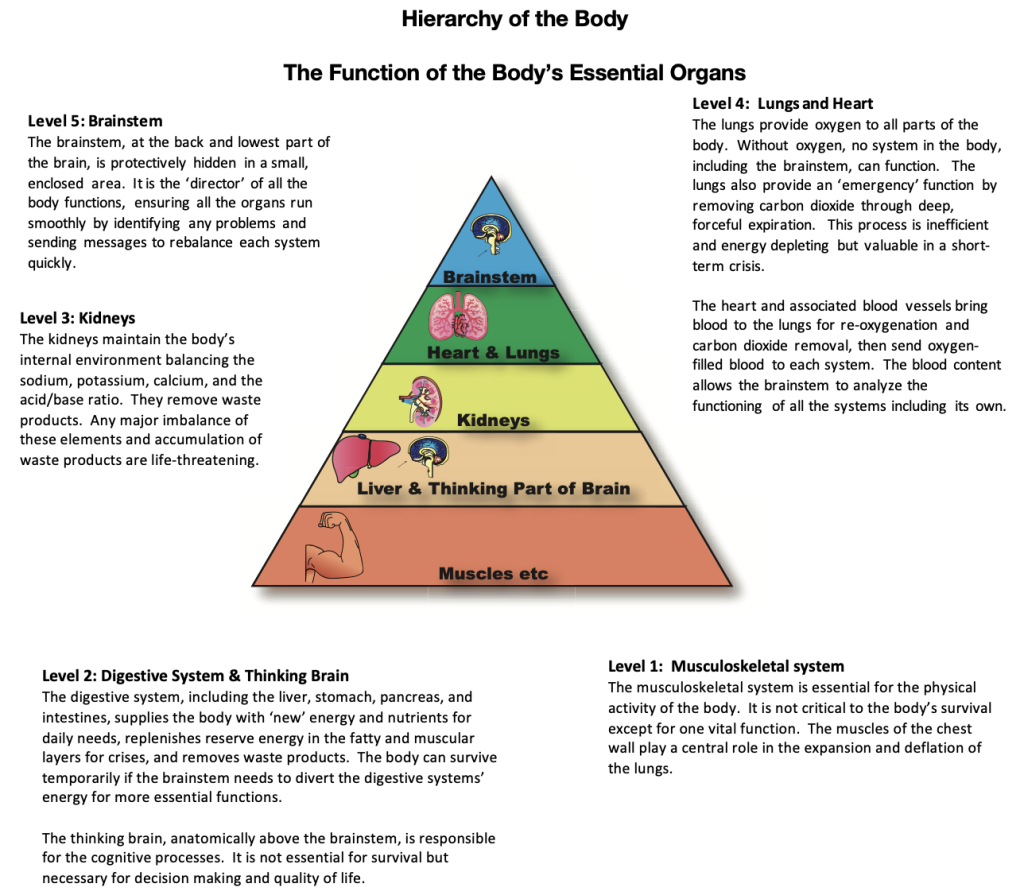
I started my teaching using my graphic – Hierarchy of the Body. Within the chart, each major organ system is placed on a level illustrating its relative importance in the body’s organization for survival. The higher the organ is placed onto the triangle, the more important its function is for survival. Using a triangle to represent the body demonstrates another aspect of the body’s sophistication. The more important the organ’s function is for survival, the higher it is placed on the triangle, visually indicating less energy required.
The brainstem is on the highest level. It is a small anatomical structure, hidden, protected, and housed in a small, enclosed area at the back and lowest part of the brain near the spinal cord. It is the ‘director’ of the survival process. The brainstem ensures that all organs run smoothly by being vigilant, quickly identifying any problems and sending messages to rebalance each system.
When the body is healthy, the brainstem remains in the background, performing its essential functions efficiently and quietly. Outwardly, we observe the operations of organs at less critical levels of the body, for example, the musculoskeletal system, the digestive system, and our sophisticated thought processes. We marvel as athletes perform extraordinary feats. We intentionally try to exercise and eat well to maintain our health and allow our body to function as effectively as possible. We build our societies with modern inventions as we interact with each other. Yet, we are usually unaware of the brainstem and its essential role in our day-to-day lives.
Perhaps, some of us have encountered the brainstem’s role briefly through a phenomenon of ‘hitting the wall’. At this moment, we suddenly need to stop an activity. These sensations are generated by the brainstem sending an imperative to the body, “Stop!” It has identified a life-threatening issue. It immediately switches the body to a ‘survival’ mode sending an imperative signal to the body to stop all non-essential activities to prevent what could be sudden death.
As a patient journeys through near-end-of-life toward death, the brainstem’s survival function becomes more obvious to the observer. Through the journey, the body’s reserve energy is slowly, but relentlessly depleted. In order to achieve its primary objective to keep the body alive, the brainstem shifts into its ‘survival’ mode, starting to preserve its essential functions for life by redistributing the body’s resources in a very coordinated and predictable manner. The brainstem quietly redirects energy from the least important to the most important functions of the body.
The heart and lungs are equally as important as the brainstem in the survival process but have more reserve potential that can be used by the brainstem to continue their most important functions efficiently for a little longer.
The heart, using its associated circulation via the blood vessels, brings the blood to the lungs for re-oxygenation and carbon dioxide removal. The heart then distributes the blood to all parts of the body, including the brainstem. Without blood flow to each organ, the organ cannot function. The brainstem uses the blood flowing through its own structure to analyze abnormalities sending messages back to the organs to ensure they function optimally.
The lungs provide oxygen to all the parts of the body. Without oxygen, no system in the body can function, including the brainstem. The lungs also provide another essential function, called upon in an emergency. The lungs can be ordered by the brainstem to help remove excess carbon dioxide from the body through deep, regular, forceful expirations. This pattern of breathing is an inefficient process and very energy depleting, but extremely useful in a short-term crisis.
The functions of the heart, lungs and brainstem are intricately interconnected. If one of the three does not have blood flow and oxygen, very quickly all three cannot survive – death is imminent.
The kidneys maintain the body’s internal environment by balancing the sodium, potassium, calcium, etc., and the acid/base levels. When any of these elements are too high or too low, the imbalance is life-threatening. The kidneys are also responsible for removing some of the body’s waste products.
The digestive system, including the liver, stomach, pancreas, and intestines, supplies the body with ‘new’ energy and nutrients for daily needs, and with ‘replenishment’ energy for the fatty and muscular layers stored for future extra activities and crises situations. The body can survive temporarily if the brainstem needs to divert the stored energy for more essential functions. The digestive system is also responsible for the removal of waste products.
The thinking brain, anatomically above the brainstem, is responsible for cognitive processes. It is not essential for survival but necessary for decision-making and the quality of life.
The musculoskeletal system is essential for the physical activities of the body. It is the least critical to the body’s survival except for one vital function. The muscles of the chest wall are crucial for the expansion and deflation of the lungs. Fortunately, this function does not require a large energy output and can be maintained for longer than other musculoskeletal activities.
The body is such a sophisticated organism!
When all is well, the brainstem, the director of all the body functions, quietly performs its duties in the background. We are not aware of the crucial role it plays.
When there is a life-threatening crisis, the brainstem’s function shifts to the foreground as it quickly goes into its ‘survival’ mode. We very quickly understand that all body functions must follow the brainstem rules!