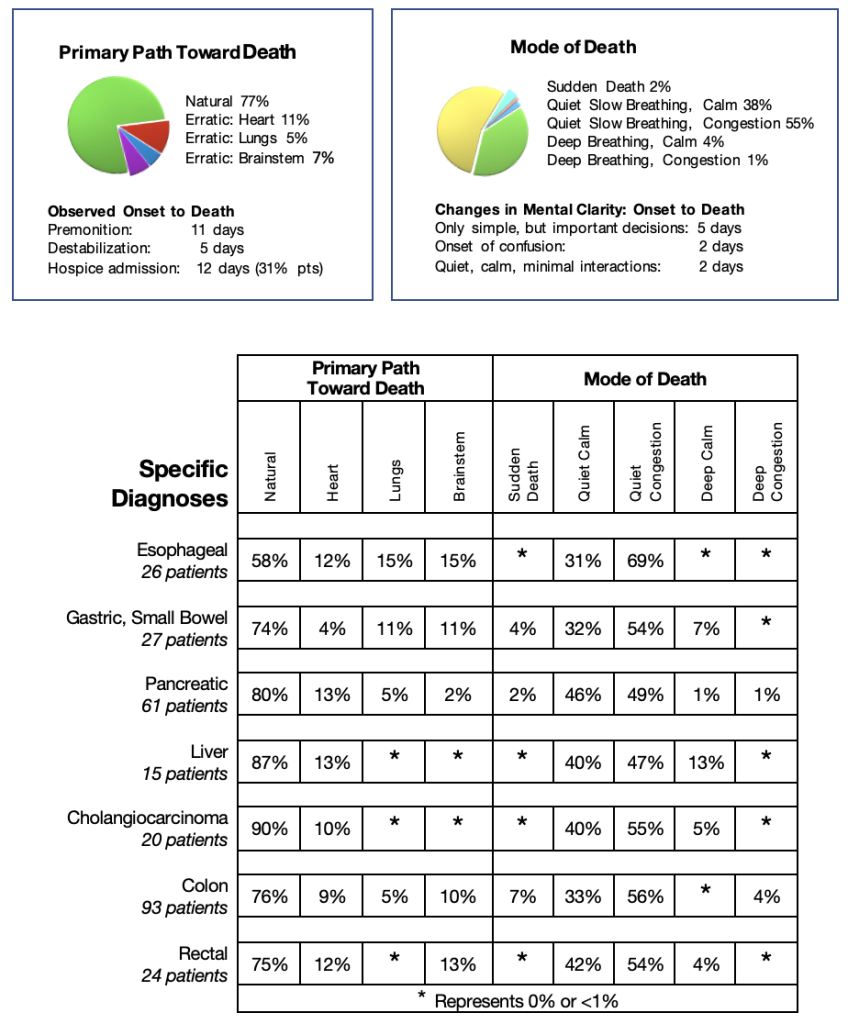
Most patients progressed through the natural path toward death due to local abdominal spread, leading to liver and kidney failure. The mode of death was usually calm, quiet slowing of breathing. Still patients often developed congestive due to heart failure requiring Scopolamine to dry the secretions.
Esophageal, Gastric, Small Bowel, Pancreas, Colon Tumours:
Surgery removed most local tumours and stents resolved most intestinal tract and bile duct obstructions allowing digestion to continue, leading to the natural path toward death. However, when the cancers could no longer be controlled, the location of these cancers, close to an abundant blood supply, allowed easy spread to the heart, lungs, and brainstem triggering the erratic path toward death.
Hepatic, Cholangiocarcinoma Tumours:
These cancers are close to the portal circulation. Local growth of the tumours caused compression of these blood vessels increasing the pressure within their lumen leading to two common complications. Stretching of the vessel walls distal to the blockage caused bleeding, leading to the erratic path toward death, triggered by heart failure. Or, through the physics of osmosis, water and electrolytes from the blood vessels seeped through the vessel walls to a space between the covering of the abdominal wall and the organs, forming a ‘lake’ called ascites. These patients progressed through the most comfortable, natural path toward death.
Rectal Tumours:
These tumours are located further away from major organs, so they are more likely to spread locally. Still, with colostomies and nephrostomy tubes to alleviate blockage of the intestines and kidneys, the digestive and kidney functions were maintained longer. Eventually these tumours spread widely through the body affecting essential organs leading to the erratic path toward death triggered by brainstem and heart failure.
Bowel Obstruction:
These cancers often spread locally blocking the intestines leading to nausea, vomiting, abdominal bloating and pain. The significance of obstruction depended on its location:
Ascites:
Accumulation of fluid in the abdomen presents with distension of the abdomen and abdominal pain. When the only symptom is mild distention, there is no need to remove the fluid. The simplest approach is to limit salt and fluid intake and prescribe diuretics to help the kidneys remove the extraneous fluid from the body.
When there are symptoms of severe pain and increasing distention, requiring potent pain medications, some of the fluid can be removed by inserting a large needle or a tube placed temporarily into the ‘lake’ of the ascites, allowing the liquid to flow out of the body by gravity or by suction. Relief is immediate; pain is significantly reduced. As with any procedure, there are dangers of removing the ascites. During the procedure, the needle can pierce a blood vessel. The bleeding is quickly controlled by simply removing the needle. The pressure of the remaining fluid compresses the punctured blood vessel.
Very dangerous side effects of the removal of large amounts of ascites occur over time. The ascitic fluid looks like urine, its removal is easy, relief of discomfort is immediate with no obvious adverse effects. The conclusion, superficially, is that large amounts of fluid can be removed frequently without any adverse consequences and very beneficial effects. The reality is the ascitic fluid is not urine; it contains all the nutrients, electrolytes, etc., that were destined to be processed through the liver, then passed to the heart and lungs and filtered by the kidneys for the body’s use. It can be argued that the ascitic fluid cannot be utilized by the body – so why not remove as much as possible for symptom control. The reality is that removing the ascitic fluid, lowers the pressure gradient from inside the blood vessels to outside the blood vessels, pulling more and more fluid into the empty space in the abdomen. The result is progressively less fluid transported to the liver and then to the heart and kidneys, eventually leading to kidney or heart failure. The premonitions of impending heart or kidney failure include the greater the volume of the ascites, the more frequently it needs to be removed for comfort and, after removal, the increasing the fatigue, the more rapid the pulse and the lower the blood pressure.
Specific Diagnosis: Rectal Cancer
Natural Path Toward Death
Pre-referral Information:
John was 75 years old when he was diagnosed with extensive rectal cancer invading the anal canal, prostate, lymph nodes in his groin and skin overlying his pubic bone. His diagnosis was confirmed by MRI and biopsy of skin lesions. He underwent a colostomy and, a month later, a course of radiation. He was sent home to recover from the operation and the radiation for a few months before his oncologists would decide about further chemotherapy and radiation.
John was ready to have treatment, but his oncologists felt he was too weak. They explained he would need symptom control and referred him to community palliative care.
Initial Contact:
My first visit with John and his wife, Mona, was at their apartment. John was in bed (I was told that he spent 90% of his time in bed) but fully participated in the conversation and decision-making. We reviewed the history of his diagnosis and treatment. I learned that he had an appointment scheduled at the cancer clinic to discuss further radiation and oral chemotherapy in the next month. It was evident that John was not considering a palliative, symptom control approach to his care yet. He felt our relationship would be for symptom control to improve his functional ability to have further treatment.
Symptom Control:
Pain was John’s main symptom. He states that he had pain, but it was well controlled with a small dose of long-acting Hydromorphone twice daily and an occasional extra Hydromorphone short-acting dose. But ‘well-controlled’ was John’s assessment. He did admit that he still had severe ‘cramps,’ described as a searing pain of sudden onset, but these had mainly settled. When questioned, he also admitted that he was in bed most of the time because of fatigue, but really because of severe pain in his buttocks on sitting.
John’s appetite was not great, but he tolerated two meals daily with no nausea; his colostomy was working daily with the occasional need for a laxative. However, he had lost significant weight since his diagnosis. He was sleeping well. He was alert, with clear mentation; his vital signs were stable.
Difficulty with urination had been addressed with the insertion of a Foley catheter in his bladder during his operation. But the physicians had not been able to remove it. It was functioning well but was due to be changed within the next few days. John was apprehensive because he had incurred excruciating pain the last time it was changed.
What could I do to begin building a trusting relationship with John and his wife on this first visit? His oncologists understood the criteria for referral to my practice, so I knew that John would not likely have further active treatment. But John did not know that and was still hopeful. His wife appeared to be more realistic through her reactions during our discussion. John was knowledgeable, well versed in many areas, keen on acquiring knowledge. If treatment were offered to him, he would want to base his decision on facts. I asked John and Mona if they wished to review the hierarchy of the body card to help explain how his cancer would likely progress, the body’s natural path toward death and what symptoms to expect.
They were both pleased to listen to my explanation. I added my assessment from the day’s visit at the end of my general description. I felt John was at the upper edge of the lowest level on the triangle. Functionally he was in bed most of the time; his showers were almost impossible; he was eating but losing weight.
How could I help with his symptom control in that first visit? I knew he would not accept an increase in his Hydromorphone. I offered to start a small dose of a steroid, Decadron, in the morning. It had an anti-inflammatory effect that could alleviate some of the tumour’s swelling, relieving some of his pain while sitting. A second benefit would be to reduce the body’s ‘overreaction’ while fighting the tumour, increasing his energy level. Whether the Decadron had no effect, or a positive effect might help John decide about the benefits of further chemotherapy and his ability to tolerate the side effects of the chemotherapy. I heard that John was very anxious about the change of his catheter. I felt I might build trust by helping with that problem. I explained that I would delay the foley catheter change for two weeks. I would visit in one week to reassess his symptoms and bring a sample of the medication, Midazolam, a short-acting muscle relaxant. I would then write an order for the nurse to give a dose of Midazolam before the catheter change. We were successful. Two weeks later, with the Midazolam to calm him and relax his muscles, the foley catheter was replaced quickly with no discomfort.
Ongoing Observations:
I visited with John and his wife two weeks later. Overall, he had improved. He was eating well, walking to the bathroom, dressing himself every few days, and sleeping well. He had a shower the previous day and tolerated it well. His pain was in reasonable control with an extra Hydromorphone tablet late in the afternoon, though he still could not sit comfortably. His vital signs were stable, and he was thinking clearly.
He was strong enough to go to his cancer clinics appointments to discuss further treatments. Even though he had recovered from the operation, the oncologist still felt he was too weak for chemotherapy. The radiation oncologist felt that his local cancer was in control, and he did not need radiation at this time. With no possibility of further active interventions, I assumed the role of John’s primary physician in the community.
I took the opportunity to address his pain triggered by sitting, explaining that it was interfering with his ability to function in his apartment and go on outings. I asked his permission to double his regular long-acting Hydromorphone as a trial. Again, we successfully expanded John’s world with just that minor change.
Over the next five months, John continued to improve his functional capacity with no significant crises. His pain control improved remarkably, with only slight exacerbations averted by walking in the apartment for a few minutes when it started. He started increasing his activities. He was up and about his apartment every day and enjoyed sitting in his living room to visit with friends and family, read, and watch TV. He dressed by himself most days by the afternoon. Then he started excursions outside his home, including some meals at restaurants with no exacerbation of his pain. I had left an oximeter for he and his wife to measure his pulse and oxygen saturations – they remained stable with his activities. He slept well. He started to have a greater appetite, at least two meals daily and digested his food well with good bowel movements. He had no problems with the function of his Foley catheter, tolerating the changes well.
Premonition:
The only outward signs of John’s cancer progressing were skin cancer lesions growing slowly but steadily over the area above this pubic bone. His wife contacted the cancer clinic to report this new finding asking for an assessment. The radiation oncologist ordered a CT scan, then a course of radiation. John tolerated the procedure well initially, but a week later, he developed severe urinary tract infections and recurrent blockage of his foley catheter worsening over the month. It appeared that the cancer tissue destroyed by the radiation continued to slip into his catheter blocking the urine flow and causing infection. The infection spread throughout his body, the backup of the urine in his bladder stressed his kidneys, leading to kidney failure. He destabilized, weakening so much that he could not empty his colostomy. He was barely able to eat, and his oxygen saturations slipped to 88%.
Symptom Control/Stabilization:
I ordered supplemental oxygen for comfort. I prescribed several courses of antibiotics with initial improvement, then recurrence again triggered by another blockage of the catheter. His wife and I thought he was close to dying. I then decided to remove the catheter as a trial to observe if he could void without it. If his urinary passage cleared, his infections would clear, and we would no longer need to deal with the logistics and complications of the catheter. And to my surprise, he had no difficulty voiding once the catheter was removed – likely a benefit of the radiation shrinking the tumour about his bladder and urethra. That was the turning point – John started to recover.
One month later, though still within the small world of his room, John was doing very well. His thinking was clearly, sleeping well, and breathing easily with his oxygen saturations always in the high 90s, while on oxygen. He ate a good breakfast every day and small snacks the rest of the day.
He completely emptied his bladder using just a urinal while lying in bed with his urine remaining clear. He dressed himself every few days. His pain was in excellent control, with no need for any extra Hydromorphone.
The Fusion of the Science and Art of Near-End-of-Life Care:
Still, there were mor subtle signs that John had not recovered to his former functional ability. He could shave and walk to the bathroom, but he did not have the energy to empty his colostomy, which required him to kneel beside the toilet. He agreed to let his wife take control of the colostomy. After a few trials, she developed an efficient and straightforward technique to clear and clean the colostomy daily with John remaining in bed. Just that seemingly small task done efficiently in bed removed a considerable obstacle to his care as he weakened and helped ensure that John would be able to stay at home with his wife until he died. John remained stable for the next two months but never regained enough energy to do activities outside his home.
Premonition:
Two months before his death, John demonstrated more ominous signs of weakening observed by Mona, who understood their significance. John was still interacting with friends in his home but needed to rest for several hours after the visits. He was sleeping more in the day, requiring a nap in the morning and afternoon, and retired early for the night. He dressed less often but would still do so for friends, refusing any oxygen through the visits. On questioning, John realized he was weaker though his pain remained in reasonable control. He was eating less but enough for his needs. His pulse and oxygen saturation remained normal. Mona and I knew he was weakening, but the premonition signs were not life-threatening. Mona understood her husband well, especially his need to keep his mind active. She bought him a giant TV and set it up in their bedroom. John could watch all his special science programs without the effort to move to the living room. He was delighted!
One month before his death, I observed and heard of more ominous changes during my visit. John was sleeping much of the time, no longer visiting with friends and eating and drinking much less, confirmed by much less stool in his colostomy and concentrated urine. He required extra Hydromorphone twice daily. John participated in the conversation but commented much less, admitting that he was much weaker. After a short walk to the bathroom, his pulse was 120 and oxygen saturation 90% on room air. After a short rest, on oxygen his vital signs returned to normal. All these factors were now ‘objective’ evidence of the premonition that John was weakening; soon, all his care would be in bed, and he would not be able to take oral medications consistently.
Since his pain was not well controlled now, I asked John and Mona to consider administering his pain medication by injection subcutaneously. I also asked the home care coordinator to start shift nursing in the daytime and send equipment for subcutaneous injections and a hospital bed. We would not make the change until the shift nurse was in place. Two weeks later, with the extra nursing help with his care, which was now all in bed, John had not progressed, and with less activity, he had less pain. He could still participate in the discussions and readily agreed to start his Hydromorphone through a pump subcutaneously equivalent to his present dose. He was eating enough for his needs and his bowels were working well. His pulse and oxygen saturation had returned to his normal levels.
One week before his death, I visited with John and his wife. John was doing well within the small world of his bed. He was voiding well but eating and drinking smaller amounts. He tolerated bed baths using a combination of a small dose of Hydromorphone and Midazolam but required a long period of sleep after the procedure to recover. His pain was in excellent control. His pulse and oxygen saturation were stable. I noticed that his breathing was normal at rest but a little laboured when speaking.
Destabilization:
Two days before John’s death, I was asked to visit urgently. The previous day, John had reported more pain, especially with his care, and a dressing change for an open wound on his coccyx. He settled well but then slept all afternoon and through the early part of the night. At 3 am he awakened and asked to void into the urinal. He did not awaken during his care and dressing change the next morning. He was asleep when I visited and did not respond to my gentle examination. His pulse was 83 and his oxygen saturation was 96%. His breathing had a regular pattern. This was the beginning of his destabilization. We requested nursing care around the clock and stopped all his oral medications. I advised feeding John only if he asked for food or drink. I did not change his Hydromorphone but changed his Midazolam to a pump with a low continuous dose and a bolus to be given whenever needed to ensure his comfort. This combination allowed Mona to quickly give an extra bolus of Hydromorphone and Midazolam if John became restless when she was alone.
One day before John died, I visited John with his wife and the shift nurse. He had passed a good night, awakened twice, without distress. In the morning, he urinated and moved his bowels before my visit, then tolerated his care without discomfort. His pulse and oxygen saturation were normal, his breathing was a little rapid, but regular.
The day of John’s death, after a calm night, early in the morning he awakened a little restless, quickly settling with a bolus of both Hydromorphone and Midazolam. A few hours later, Mona called me to report that John’s breathing was becoming congested.
I advised her to give a bolus of Hydromorphone and Midazolam to keep him comfortable until the shift nurse arrived and I arranged to visit urgently. An hour later, before the nurse and I arrived, Mona called me. She reported that John settled after the boluses but continued to weaken and ceased to breathe quietly with her at his side just before the nurse arrived.
Timeline to Death
Predicted: 1-2 months Actual: 12 months
When John was diagnosed, his cancer had already spread extensively locally and could not be surgically removed. He had an impending bowel obstruction which was alleviated by a colostomy. With this procedure, as the disease progressed, he could always nourish himself until his brainstem switched to a survival mode and did not allow his body to digest food, preserving energy for more essential functions.
We had an ‘objective’ sign that John’s disease was progressing by observing the growth of satellite lesions on the skin of his lower abdomen. Likely, his cancer in the pelvis was also enlarging. The course of radiation had two benefits. It destroyed a large amount of that hidden cancer in his pelvis and therefore gave John three more months of good quality of life by reducing his pain and allowing him to void without the use of the catheter. Still, the treatment almost killed him, leading to severe infection and urinary retention. The symptoms demonstrated during the deterioration gave us a ‘premonition’ of what he would face when he started to progress again and demonstrated to us just how fragile he was. He followed the ‘natural’ path toward death, accelerated by increasing kidney failure leading to a steady but rapid progression beginning in the week before he died.