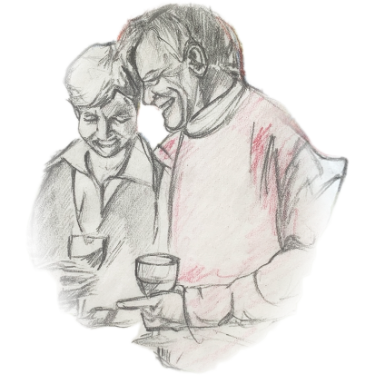
A year after I returned to Canada after from Malawi, my siblings and I experienced near-end-of-life journeys alongside close family members. In the next 11 years, we lost our mother, our grandmother, and our father. My siblings and I had never experienced the death of any close relative during our lives. Our grandfathers died before my parents were married, both from infectious diseases. Our paternal grandmother, diagnosed with skin cancer when in her 80’s, was cared for by her daughter. We heard about her death, but we really did not know her, and we lived too far away to go to the funeral, so there was little emotional impact. However, the loss of our nuclear family members fueled our understanding of the integration between the science and art of care at near-end-of-life.
My mother, 63, was diagnosed with cancer of the cervix and died within a year. We cared for her at home until her death. Despite an early diagnosis, attentive and aggressive medical interventions including radiation and surgery, she had only one day during that year when she was well enough to enjoy an excursion outside of her home. We felt her journey was much too short – and felt anger.
Two years later, my grandmother, 91, developed pulmonary fibrosis. Her retirement home caregivers could no longer care for her needs, and she had no family in Quebec City. We offered to bring her to our home in Ottawa for her near-end-of-life and she agreed but grudgingly. I had travelled to Quebec City to assess her condition and discussed with my family and her son that she had about three months to live. She died 14 months later in our home. At times we felt her journey was too long – and felt guilty.
My father, 87, was diagnosed eight years later with cancer of the bladder and died within one year. After initial treatment with radiation, he had a good year until his last week, living his life as he wished. He had a very good friend, Marie, a former nurse. He decided to spend his last few days in her home, feeling that she would take the best care of him, with our family providing additional support. We felt that he had lived his near-end-of-life his way – and felt we had supported him well.
When I was living through my mother’s illness, two concepts were very clear to me in the whirlwind of emotions I was feeling. First, I knew that we would take care of her at home until she died. I knew my mother well, she hated and feared hospitals. She had done so much for our family in each of the moves to different parts of Canada. We needed to do this for her.
Second, I was sure we would succeed to provide the care at home ‘because I was a doctor’. I knew the science of what would happen. I knew the medical and community resources. I would be able to handle all the crises or know how to access the people who could help us.
When I was living through my grandmother’s illness, these same two concepts were still very clear in my mind. But two more concepts evolved through the length of our care for her. First, although, I had met my grandmother about a dozen times in my life, for about a week each time, I really did not know her well and therefore, I did not have a strong emotional tie to her. I could approach her care very much as I did for my elderly patients in my family medicine practice. Still, I soon realized there was one major difference. In caring for a family member, I was responsible, with my family, for her care twenty-four hours a day, every day. I went through all the emotions and frustrations my patients’ family caregivers faced caring for their loved ones over an extended period. The experience gave me invaluable insight and a deeper empathy in caring for my future patients and families. Second, living through my second personal near-end-of-life journey, with less swirling of powerful emotions, I realized that I had not grieved my mother’s death. I felt great solace slowly over the months, step by step reliving my mother’s journey as I cared for her mother, understanding my emotions through this new, longer, and slower journey.
When my father was diagnosed with cancer, I instantly and vividly remembered my experiences in caring for my mother and grandmother. And, I had now spent three years immersed in palliative care. I thought, through this journey with my father, I could better support my father and my family, helping to communicate with each other as a family.
My father had other ideas. He used his final life journey to teach me a great lesson in humility, clarified my role in our family and opened my eyes as to how I could find the ‘elegant’ solutions for my patients and families at their near-end-of-life.
My father had learned, much more than I realized, through his journeys with his wife and mother-in-law at near-end-of-life. He now had a loving relationship with Marie, a former nurse. He made it very clear to his family that he would live his life his way, using the skills of each of his children and his friends to his benefit. Although we did not discuss these issues in-depth, (it was not our way) I confirmed his vision of near-end-of-life a few months after he died when I found a short video he had not shared with us. He had recorded at it a regular two-year reunion of his university buddies – those still alive. Everyone who came to the reunion presented a summary of their lives since the last reunion. My father was not a great communicator.
I think he wanted us to view this video after his death to reassure us that he had confidence in our care for him. The essence of his video was, “I have been diagnosed with bladder cancer. I know that I will die from this. I am not fearful of dying. I have had a good life. My daughter, a doctor, cared for her mother and grandmother at our home. My companion is a retired nurse. I know they will care for me. I have no worries. I will continue to live my life until I die.” And that is exactly what he did.
During our journey, I learned another truth that would be crucial for my future practice. Reliving my previous journeys with my mother and grandmother at near-end-of-life while I was caring for my father, I realized that I did ‘not’ play the role of a physician while I cared for them. Rather, I played the role of a loving daughter and granddaughter who had knowledge of the science of what was happening within the body as it approached death. I knew the resources available in the community and ensured they had the medical care they needed. This was important, however even more important, I knew my mother: her needs, her fears, what was important to her, how she communicated, and what she felt inwardly without speaking. My father and uncle knew my grandmother. Through them, I grew to know her needs and fears. Knowing each family member was the part of the care that was unique. I was able to optimize their care, using my father’s ‘elegant’ solution approach, or now, as I called it, the ‘art’.
After my mother’s last operation, unsuccessful in relieving her bowel obstruction, the science told me her death was imminent within one to two months. Our family ‘mobilized’. My brother took care of organizing the equipment we would need; my youngest sister took care of grocery shopping, ensured meals were prepared and brought her daughter to visit; my father provided care during the day. I was responsible for her at night while still working during the day. My uncle made a trip to Quebec City to bring their mother to visit. My sister in Calgary arranged a trip to Ottawa. My oldest sister brought her three young children to visit their grandmother every week since my mother so loved her grandchildren!
The science told me what would happen, still, I advocated for her as a daughter not as a physician understanding what comfort needs would be important for her. Her physicians had already placed a drainage tube into her stomach to prevent vomiting, but I knew she would become very thirsty not being able to absorb even fluid. I asked for a central, easily accessible intravenous line to give fluid for comfort only. They agreed.
Other decisions supported her comfort. Her physicians had prescribed an injectable Morphine dose at night. I simply administered the simple injection into her thigh nightly.
She remained pain-free and mentally clear until her last few days. She did not need any adjustment in her medications. My mother was obviously very weak and did not wish to soil her bed, so I asked for a Foley catheter to continuously empty her bladder. When it was inserted, the relief on her face was so obvious!
Our family, in our own way, added the art of our family’s care in a variety of ways.
Our family had never been great communicators. We were not able to demonstrate our love well with words. We quietly showed our love by “doing” and by “being there.” For me, there were a few very poignant moments when my mother and I showed our genuine love. After her last operation, I was left alone to tell my mother the ‘bad’ news. When she looked at me, I suddenly burst into tears. She understood immediately and tried to be ‘a mom’ by holding my hand and saying, “Don’t cry, honey. It will be all right.” A few days before she died, while I spent the afternoon reading beside her bed, I noticed she was quietly crying. I asked what she was thinking about. She stated, “It is hard to leave my beautiful grandchildren.” I knew that now she felt her death was imminent.
After completing the challenging visit with her mother, she settled into a comfortable routine. Then, one day my mother looked at me and asked, “Do you think I could have some Concorde grapes?” My mother and I ‘loved’ Concorde grapes and they were in season. I decided to give them to her – as a daughter who knew the importance of this treat to her and knew that she would not mind a brief episode of vomiting. A physician would have thought the decision crazy. I bought the grapes, set her up with towels and a basin, and sat with her while we both had a handful of grapes. The looks of rapture on her face made the consequences worthwhile. Yes, she vomited, but it lasted just a short time and was easily handled.
A few days before my mother died, my father and I were faced with what we felt was a crisis. My father called me in the middle of the night, stating that the intravenous was not working. We had previously discussed if this happened, we would simply remove it. But we had made that decision with our ‘brain’, logically. Now we looked at each other and had to make the same decision from our ‘heart’. When emotions are swirling, with the thoughts of a loved one dying, guilt becomes part of the equation, which leads to doubt, which raises questions like, “Maybe if I remove this tube, maybe, just maybe, I am hastening her death.” We knew, logically, that removing the line would not hasten her death, but with our ‘heart’ we knew it made the fact her death was imminent – real!
After a few minutes, we did remove the tubing. To our surprise, though it was not functioning, it was not blocked. I saw this as a sign. Yes, it was the right time to remove it. She died two days later, very comfortably, free of the tubing that had needed our frequent attention – a distraction from just being with my mother.
As a physician, I knew the science. I knew that removing the line was a good decision ensuring we did not give her too much fluid directly into her heart which, in the last hours, could have led to heart failure and congestion, causing significant discomfort. Still, as a daughter, it felt like a difficult decision.
The day before she died, an experienced community nurse made a routine visit. That morning I had given my mother a complete bed bath, changed the bedding, and settled her comfortably to one side. My mother responded very little and appeared so very comfortable. When the nurse arrived, she sat beside me, and while talking with me, she quietly observed my mother’s comfort and condition. She just let me talk about what was happening, occasionally asking a few questions. To my surprise, the nurse terminated the visit without examining my mother. She just trusted my care, and looked at me, smiled and said, “For a doctor, you are an excellent nurse!” I remember that comment to this day. And it still brings tears to my eyes. It was so relevant. I could not communicate well using verbal communication, but I could demonstrate my love by ensuring my mother knew I was there and keeping her comfortable.
On looking back over the years of my near-end-of-life practice, I have used that nurse’s validation technique often with my patients’ families. If I observe a family struggling, wondering if their care is adequate, but I know that they are doing well in the care of their loved ones, as I am leaving, I will look directly into their eyes and say, “I hope you realize you are taking wonderful care of your loved one.” Usually, tears well up in their eyes and relieved they say, “I am doing my best, but I wonder at times if I could do better.” As I became more experienced, it was easy to add. “I have been doing this for a long time, and I know that you are doing well.”
The day my mother died, I made sure she was comfortable in the morning; I observed no objective changes in her condition. As I was leaving to go to my office, I passed by her room and heard that her breathing had changed to a deep, regular pattern. As a physician, I recognized this breathing and knew her death was imminent. I cancelled my office for the day and stayed beside her with my father. We were holding her hand as she died very quietly, in the next few minutes.
I predicted that my grandmother would live about three months. I was wrong! I did not factor in the benefit she would derive from the transfer to our home, coming into a caring environment surrounded by family. And we mobilized to care for her!
My father felt he owed her a debt for the year she had helped my mother care for his four children, all under five years of age, when he was sent to Japan during the Korean War. For his mother-in-law’s care, he provided the home, the simple meals, with my sister helping with shopping and preparation. He took the day shift while I was working. I took responsibility for the evening and night shifts. My sister came to sit with her if I had a patient crisis in my practice in the evenings. My grandmother’s son visited every day for several hours. My other siblings, with their children, and my uncle’s family visited in a rotating fashion. I asked a colleague to provide her medical care, but after the initial visit she did not require medical interventions. She had no oral or injectable medications throughout her illness. After her initial stabilization, slowly over the next year she slowly lost more and more lung capacity, reducing her energy for activities, and shrinking her world relentlessly.
Her journey illustrated a typical example of someone with a non-cancer diagnosis at near-end-of-life with no crises, simply a loss of energy leading to an increasing loss of independence.
At the onset, our family prepared for and was pleased to provide her care. But the responsibility over time started to take its toll. One day, my father came to me and asked, “You told me she would die in about three months. It has now been a year. I don’t understand. Is she going to die soon?” He had a new relationship with Marie and wanted to live his own life, spending his time with her. I reassured him, I could see my grandmother’s world getting smaller. I knew she was deteriorating, but I really could not make another guess for him as to the timing.
My grandmother’s personality became more obvious and caused frustrations. My grandmother was an expert in making anyone feel guilty. She had always been this way in her interactions with my mother. As she grew weaker, that behaviour only increased. At one point, we started to have a Sunday round table session of her caregivers to discuss, “What did she do to you this week to make you feel guilty and frustrated?” Her son, who visited every day for several hours, left each day with his mother saying, “Maybe tomorrow you could stay longer, you know I am very sick.” My sister, who stayed with her when I was called to deliver a new baby, was presented with a five-dollar bill, and a comment, “Maybe you will come and stay with me again another day.”
With me, when I sat beside her one evening, while working on my bundle of patient files, she said, “Thank you for staying with me, perhaps you could do this more often.” We learned that she would not change – she was set in her ways and too weak. We had to be the ones to adapt to her.
We learned how difficult it could be to deal with failing functional ability in a fiercely independent person. As my grandmother started to weaken, I observed how much effort it took for her to perform her crucial activities of daily living. We knew ways to help her, but she would not let us help her. At one point she did admit to not feeling well, refused to listen to my explanations and repeatedly asked for a physician visit stating, “I know you are a doctor, but I need a ‘real’ doctor.” I asked one of my family medicine residents, a young physician who spoke French, to visit, mostly to appease her. When he arrived, she was sitting in bed, with a new night gown, looking very comfortable and pleased. My resident asked her, “How are you?” She looked at him with a beautiful smile and stated, “I am just fine doctor, thank you for asking.” By the end of the visit, she did admit to some breathlessness, so he ordered supplemental oxygen if she became breathless.
As she weakened further, I observed how difficult it was for her to walk the short distance to the bathroom. I offered her a urinary catheter. She stated in no uncertain terms, “No! You are not going to put that tube into me!” I offered her a bedside commode. She refused stating, “The seat is too cold, and the hole is too big – I would fall into it.” I offered her a diaper. Of course, that was not acceptable for a grown woman.
Before she had a major fall, my father went to work on an ‘elegant’ solution for the commode problem. He constructed two removable sheep skin covers for the commode. The material was very warm to the buttocks, the thickness of the material made the commode hole much smaller, and they could be washed every day. She was amazed, and immediately accepted the solution. Problem solved – falls were prevented.
However, that did not solve the problem of her bowels. My effort to help my grandmother with her bowels did not go very well, but it was an excellent lesson in humility and insight for my future practice. She would have been so pleased that she had taught me about the care of bowels which helped others in the future. In my grandmother’s generation, adults were fixated on regular, daily bowel movements. Every Spring, the adults in my mother’s family took a cathartic to ‘clean out their bowels’, releasing all the ‘bad poisons’ they had collected over the winter. Fortunately for my siblings and I, my mother did not believe in this routine. My grandmother used milk of magnesia daily throughout her life. When she was weakening and barely eating, she spent up to three hours sitting on the commode every day to have this ‘essential’ daily bowel movement.
Several times I tried to explain to her the principles of bowel movements and that she did not need a daily evacuation when she was eating so little. After a few of these sessions, she sat me down, looked directly into my eyes and said, “You are a doctor and know a lot about medicine. I am now 91 years old, and I have been looking after my bowels all my life. I know my bowels much better than you do. I will deal with them my way!” So, she did. I, simply, had to deal with the consequences – some very loose stools and several accidents. It was a small price to pay for her to maintain her sense of control and independence until she stopped eating a few days before she died.
Accessing community resources for palliative patients with very few symptoms was challenging. I waited and waited until I felt it was the appropriate time to ask for help. We started to observe the clues of my grandmother’s progression – increased weakness and need for more help for her hygiene. I knew, as a family physician, she now qualified for community resources, perhaps regular visits twice weekly for personal care. Her physician made the request. The case manager visited, and I explained the changes and her needs. In looking at the situation, the case manager stated, “You are doing an excellent job. You do not need the community resources yet.”
If I had been acting as a physician, within my practice, I would have advocated for my patient and family, but I was the family and found it challenging to play that role for myself. Instead, my uncle, my father and I shared the cost of hiring nursing help four hours in the morning, Monday to Friday. It freed us from the ongoing increasing daily care. We made sure there was consistency – always the same nurse, and that she spoke French. My grandmother felt she was a princess! Win, win for everyone. Of course, with the extra personal attention and less need to expend energy, she rallied a little, though remaining very frail.
Families intimately involved with the care of their loved ones are the first to sense a premonition: a feeling of being on the edge of the precipice; a crisis will happen soon; we need to prepare; death is coming soon! For my grandmother, this happened one night when she called me four times through the night. In the past, she never called me at night. She asked for tiny things: a sip of water; moving her pillow or stating she could not sleep. After fulfilling her last request, I asked her if she was frightened. She looked at me and spoke, “You know I am tiny.” I said, “Yes, I know.” She said, “The bed is quite large. Could you stay beside me?” I realized that she thought she might be dying. She was frightened, and I assumed she did not wish to be alone. I pulled up a chair and slept a few hours beside her. After that night, I made sure I stayed with her each evening until she fell asleep.
I knew that after an ominous premonition, a destabilization event could occur very quickly, especially in a patient with respiratory problems. A few days later, as I woke up, I could hear that she had slipped into a deep and regular breathing pattern. I knew this was a powerful sign that she was close to dying and that her kidneys were failing. Still, her breathing was so regular with good effort and with no distress. I did not think her death was imminent and I could sleep another hour. (I am NOT a morning person!) An hour later, I could still hear the deep and regular breathing pattern. I went into the room and held her hand. She opened her eyes and gave me her ‘look’, which, from experience, I knew meant “It’s about time!” She then closed her eyes and stopped breathing. She did not wish to die alone. She was strong enough to wait for me and let me know just how much effort it took. She was my grandmother to the end!
My father was followed by a regular family physician attached to my former family medicine group. After he informed me that he had blood in his urine, he told me he would make an appointment and go through all the necessary investigations. He did not need me to be with him at these appointments. Marie, his nurse friend, would drive him and be with him.
My father did request my presence at the meeting where the specialists discussed treatments. He had a significant hearing impairment and felt he would miss the nuances. The physicians made great efforts to talk directly to him, but, at times, they spoke quickly and softly. I listened carefully and observed the interactions during these treatment discussions.
My father had a single two cm lesion in his bladder wall. The oncologists felt that he would be a good candidate for their new trial requiring both radiation and potent chemotherapy concurrently. They explained the combination would be very hard on him with the potential for serious side effects, but they hoped it could give him a good chance of cure. The older, more conservative approach, a course of radiation to stop the bleeding and shrink the tumour, was still available. I could tell the physicians were focused on recruiting my father, who ‘looked’ relatively healthy, to their new study.
I knew my father’s medical conditions very well. He had been in the army from the 1940s to the 1960s. Army officers had their own unique culture. They were often heavy smokers and frequent social drinkers. He had had high blood pressure and chronic lung disease for many years, and a minor stroke a few years before his cancer diagnosis. I knew he would be the type of patient most likely to have the severe side effects of stroke, blood clots, etc. while participating in the new aggressive treatment.
The physicians left that interview, pleased that they had discussed all the issues clearly, feeling that my father had understood. They were certain he would choose the experimental approach. And to be fair, my father looked at them throughout the interview, nodded appropriately and smiled as they left, agreeing to think about the options. Of course, the physicians surmised he had understood everything.
On leaving the appointment, I looked at him and said, “You didn’t hear or understand a thing they said, did you?” He said, “Nope, but I knew that you would hear and understand. That is why I wanted you to be present. Now we can go home, and you will tell me exactly what they said, what they meant and explain my options and the risks. Then, I will make my own informed decision.”
As I explained carefully, in a language my father could understand, I could see the ambivalence in his body language. It was apparent that he would not choose the highly aggressive approach. His journey with my mother was still fresh in his mind. She had agreed to very aggressive treatment, and in that last year, she had only felt well enough to leave her home once for a short shopping trip before she died. Yet, I could see he did not want to refuse all treatment. He wanted to live well with his children, grandchildren, and his new companion as long possible.
Even I, an experienced physician, almost forgot from the conversation with the oncologists that there was an alternative treatment they had suggested that might be acceptable to my father. I reminded him that he could undergo the non-experimental treatment – a six-week course of radiation to shrink the tumour in his bladder and stop the bleeding. I explained that there would be no further treatment once the radiation was finished. Then, he could live his life his way. His eyes lit up, and he quickly stated, “Yes, I will do the radiation.”
He did not need me to bring him to the routine radiation appointments. He enjoyed having Marie fulfill that role and take care of him. About midway through the radiation, he developed a complication seriously impacting the quality of his life. My father had severe allergic reactions to some foods and insect bites and suffered from extensive psoriasis throughout his life. He developed a total body allergic reaction to the radiation that he did not share with me until he decided to stop the radiation.
He knew the physicians would not like his decision, so he asked me to accompany him to the appointment the next day. He simply told me, “I have this terrible rash over all my body. I am sure the radiation has triggered it. Would you please accompany me to the appointment and tell them I have decided to stop the treatment? You can do that much better than I can – these physicians won’t push you around. I will do NO more radiation.” I knew my father well. I knew that no argument the nurses and physicians could present would convince him to continue the treatment.
So, I played that advocacy role for him. But my hidden agenda was to advocate for the treatment of his rash. I knew the science of his extensive rash. While we were seeing a series of nurses and physicians, I asked the physicians to prescribe a small dose of Prednisone to alleviate the incessant itchiness and discomfort. They agreed.
My main advocacy role for my father, to convince his specialist to stop his radiation, took much longer. He had been so right to ask for my help. I quickly understood why he wanted me to be his voice. First, I had to explain his decision to the nurse, then the resident, and then the consultant physician. No one thought the decision was in his best interest. Everyone tried to convince him to continue. They only permitted my father to stop the radiation if I agreed to use a marker every day to keep the radiation dots visible if he changed his mind.
On leaving, he asked me, “Are you going to do that?” I smiled and said, “Of course not, but I did get you out of the office, and the treatment has been stopped!” Then, I asked him, “Will you use the Prednisone for your rash?” He smiled and answered, “No.”
I knew my father would initially refuse to take the medication. Instead, he enrolled his companion and me to lather him daily with Hydrocortisone and Vaseline cream. I disagreed with that choice, but I knew he would make his own decisions, so I lathered him with cream daily. Being a realistic and practical man, I hoped the reality of the constant itch would eventually persuade him to take the Prednisone. I merely kept the Prednisone within his reach.
The itching did become more intolerable, and yes, my father reluctantly started to take the Prednisone, but only as a trial and only for a few days, vowing to stop it if he had any side effects. About a week later, he showed the medication bottle saying, “Look, these are such tiny pills, and only cost a few cents a pill. Why did you not give me these pills years ago? Look, my rash is almost gone. My psoriasis is in better control than it has been in years. I am feeling well with so much more energy! Can I keep taking these?” I just smiled and referred him to his family physician.
This small part of my father’s journey illustrates one of the nuances of advocacy. I agreed with his decision to stop his radiation treatment and had no difficulty with my scientific knowledge to be his advocate. I also knew scientifically that I could give him get relief for his intolerable skin rash, with minimal to no adverse effects. I knew that he would refuse to take the Prednisone tablets. But there was a chance he might change his mind, so I advocated for him without his permission and had the medication available. Still, I did not pursue the discussion further. When he decided to try the Prednisone tablets, it was his decision. And when it worked, it was perceived to be my fault he had not done so before—a small price to pay for his comfort.
As advocates, physicians, or family members, we must find that fine line acceptable to our loved one. On one side, we must make sure our loved one has the necessary information to make their informed consent. On the other side, we must allow them to decide for their reasons, not for our reasons.
After terminating the radiation treatment, and clearing his skin rash with the Prednisone, my father was now totally pain-free. He had no bleeding from his bladder, and he was feeling better than he had for years. He was sure he had made the right decisions for his treatment and would never restart active treatment. Still, he continued his small dose of Prednisone until he died! Now, he felt well enough to plan for his near-end-of-life.
My father remained well for nine months. He went with Marie to the reunion of his university colleagues in Quebec City in the autumn, then to Marie’s Florida condo for a few months in the winter.
In the spring, he set up a family reunion with his sister and her children in his hometown in Quebec. He also invited his own children and his friend, Marie. At that reunion, he had another role for me to play without warning me. He had not told his sister and her family that he was dying of cancer. At the end of the meal, he simply looked at me and told them that I would explain to everyone what was happening to him. It came as a shock for them. They expected that he was about to announce his wedding plans, not that he had a terminal illness.
In the early summer, he set up two short day trips, one by boat and another by train to tourist attractions in the Ottawa area and invited anyone in the family who was available to join. He was trying to continue our family links, but he also wanted to sit back and watch his grandchildren one last time.
My father had a passion for gardening. My youngest sister, the gardener in the family, knew just how much he loved his flowers and set up a beautiful garden for him in the spring. On his way out of our home, his garden was all around him. But he was so focused on his excursion for that day that he took no notice of it. This behaviour was so unusual.
My father adamantly wished to keep a promise made to his companion Marie to attend a family wedding. He knew he could not climb the stairs to the church. So, he enlisted my brother to build a ramp to the driveway, to rent a wheelchair, and to find four strong men to lift my father and his chair up and down the flight of stairs at the church. My father had a fierce determination to fulfill this promise.
As a family, we observed these changes in behaviour. By his actions, we knew he was aware of his diminished physical capacity, but he was not ready to share that knowledge with us yet. Then, a week before he died, he called me on the phone and simply said, “It is time to mobilize.” I knew exactly what he meant. He no longer had the energy to leave his home, so he had to decide if his home would be with me or with Marie. Marie and I were prepared to accept whatever decision he made. It did not surprise me that he decided Marie’s house was his home. Since his illness, it was always Marie he asked to help him with his day-to-day needs. Our family was ready to join Marie, whenever
needed. My father was still in charge. He orchestrated how the next few days would progress. My brother was delegated to set up the hospital bed and bedside commode. My youngest sister handled the groceries and meals. My uncle was tasked to contact a priest friend from his university days. My father asked my brother to oversee the funeral arrangements. He wanted a short, simple ceremony, with his priest friend directing it. My father even prepared a special commemorative portrait for his funeral. His very artistic granddaughter was commissioned to draw a portrait of him, accompanied by a poem he had written as an overlay.
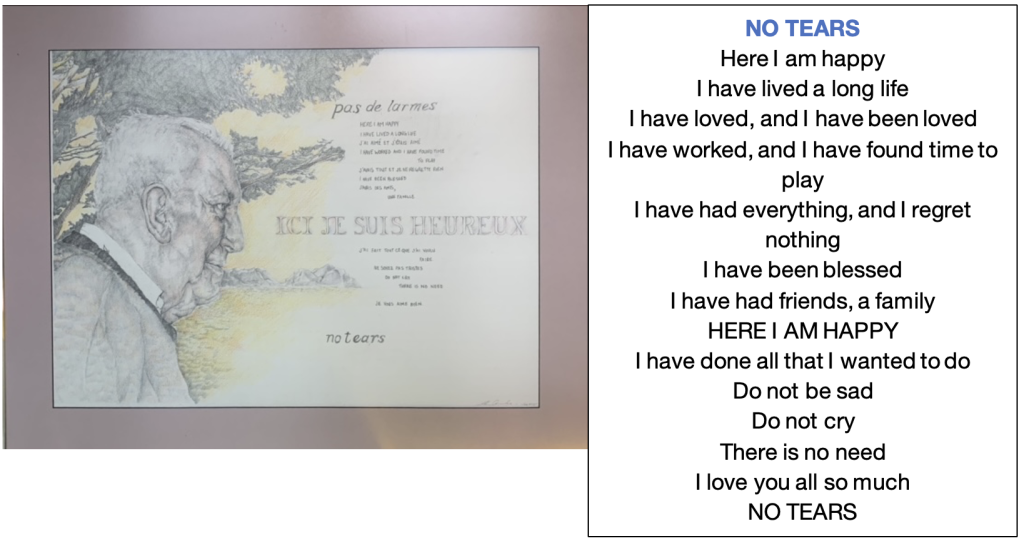
Created by Aimée Coulombe (July 1996)
After he made all his arrangements, he continued to deteriorate quickly. Within a day of the transfer to Marie’s home, he could no longer transfer out of bed. He was a heavy man, so my youngest sister arranged a schedule to always have one of us with Marie in her home.
Still, he was mentally clear. I started to wonder if I was missing something. I asked my palliative physician colleague to visit. She immediately looked at me and stated that he was in renal failure. How could I have missed that? Now, realizing that an essential organ was failing, I knew he did not have long to live. My colleague made sure there were injectable medications in the home, and the orders were written so I could administer them if needed.
I returned to Marie’s home that evening. I walked into the room to see my father sitting upright in bed. His body’s entire skin area was ‘blue.’ Marie was not concerned because he was talking and mentally clear. I looked at him for a few minutes. He was not distressed, but his blue colour was evidence that he was not getting enough oxygen and would die within minutes to a few hours. I told him, “You are going to die soon.” He looked at me with a wry smile indicating, “You’re telling me something I don’t know.” I repeated. “No, I think you are going to die very, very soon.” He looked at Marie and apologized. “I thought it would be a little longer.”
Marie was not sure what to say, so she simply asked, “Do you want something to drink, a little orange juice?” He agreed, so she went to get the orange juice. I prepared a dose of Scopolamine, a drug with drying effects, to prevent the distress of sudden heart failure. He took his orange juice. After he finished, I explained I was injecting a medication into his arm to prevent discomfort and reassured him that Marie and I would be staying with him. I hoped to make sure he was comfortable first, then, I would phone my siblings to explain what was happening. Immediately after I completed the injection and removed the needle, his eyes turned up, and he took one breath and died.
Marie’s reaction was immediate. She looked at me and said, “You killed him!”.
In the emotion of the moment, Marie had not believed my father was so close to dying because he was alert and thinking clearly, able to drink. When he suddenly stopped breathing, her initial conclusion was – it must have been the injection. My father’s companion was a nurse. She knew rationally this was not the case, but emotions took over her reaction.
I was a physician. I knew anyone whose skin was blue, no matter what I did, would die quickly. And I knew scientifically, with such poor circulation, he would not absorb the medication for at least 30 minutes or more. I had given the drug as a precaution, if he lived long enough to have signs of congestion causing distress. I knew all that, rationally. But in that instant, when Marie said I killed him, I had a tiny doubt in my mind for a few seconds. Quickly my mind cleared back to reality, and I reassured Marie. By then, she also knew it was not the medication that had caused his death.
When sudden death occurs, the people left behind often feel guilty, worried they did something wrong, worried the last activity performed or the previous small injection given caused the sudden change.
Unfortunately, this fallacy is perpetuated by scenes in numerous TV shows and movies. Visualize a movie scene where a person, in a rage, is attacking someone else. Some person comes by and gives an injection – the person loses consciousness or dies instantaneously. This is a myth!
In caring for my father, he taught me that families can learn about the process of the near-end-of-life through their past experiences, and they can tolerate and understand the reality of what is happening. With that knowledge, they can make their own decisions. My family instantly ‘knew’ the premonitions of his impending death. My colleague diagnosed his progression as kidney failure and ordered the necessary medications. When I visited only a few hours later, I knew he had destabilized very quickly and would die within minutes or a few hours – that was the science. But my reaction as a daughter was staying with him and his companion as he suddenly died – that was the art of care.