As I had planned, after two years of providing palliative care in the community, I took a six-month break. I rested, travelled to visit family, and reflected on the first two years of my CPCN practice. I felt I had made some positive inroads into the delivery of near end-of-life care in patients’ homes. The referrals continued during my hiatus, waiting for me to accept them when I returned to work.
I concluded that, although my practice was far from perfect, I was able to help the patients and families under my care. Therefore, I decided to continue this community practice for at least two more years. Initially, I did not plan to make any changes with my approach to care, but my patients and families presented me with new challenges with respect to the understanding of their circumstances and my role in their care. Most families no longer asked for an initial meeting away from their loved one. One day, as I introduced myself, my patient’s wife stated, “Yes, I know who you are, what you do, you do not need to explain further. Thank you for agreeing to be our physician.” Taken aback, I asked, “Did I care for some of your acquaintances or another family member?” They answered, “No, but we read the obituaries, and your name often appears with very positive comments. So, we know you must be a good doctor.” I was very pleased with new willingness to discuss the realities of near-end-of-life.
A few months later, two families spontaneously took another step to understand how their loved one’s disease would progress. Together, we had addressed and stabilized their loved one’s initial symptoms. The family knew this sense of well-being would be temporary. They decided to vent their frustrations, stating that they had asked many physicians throughout the cancer treatments to, please, just tell us, “How long will it be? “What will the journey be like?” They felt that knowing those answers would have made planning for the care so much easier, but no one was willing to give them an answer. They looked at me and said, “Now, we are asking you the same questions. Please, don’t just tell us that you cannot predict the outcome.”
I felt these questions asked by my patients and families were significant moments in my approach to the care of patients at near-end-of-life in the community. This need, recognized by the patient and family, to understand the ‘science’ of the body’s path toward death was vital knowledge that would allow them to be an integral part of the caregiving team.
Over time, these families would reach an even higher level of understanding than the professional caregivers because they knew their loved one the best – their needs, what made them happy, and what was important to them. They would be able to add unique ‘art’ to their loved one’s journey toward death. These two occasions were the first time I had been directly addressed with these questions. I needed to formulate an explanation that would be helpful to all.
The Hierarchy of the Body: The paper towel story
I decided to respond to these two questions starting with an explanation of the body’s hierarchy and the changes that occurred as the body approached death. This was the basic scientific knowledge I used in assessing patients. With this understanding, I interpreted the significance of my observations, adapted the frequency of my visits and made plans to prevent or control impending crises before they occurred.
The first two times I had this discussion with the patient and family, I happened to be in the kitchen of their home. As I looked about, I found an unused paper towel to illustrate my explanation. I am not artistic, but I took the plunge.
I drew a triangle and separated it into five sections by horizontal lines. I then set-up the hierarchy of the body. I placed the names of the body’s essential organs for survival onto the triangle: the brainstem on the uppermost level, the heart and lungs on the next highest level, the kidneys on the third level, the liver and thinking brain below the kidneys and the musculoskeletal system on the lowest level.
Using this diagram, I explained the function of each essential organ and the process as the body’s energy depleted due to a life-threatening disease.
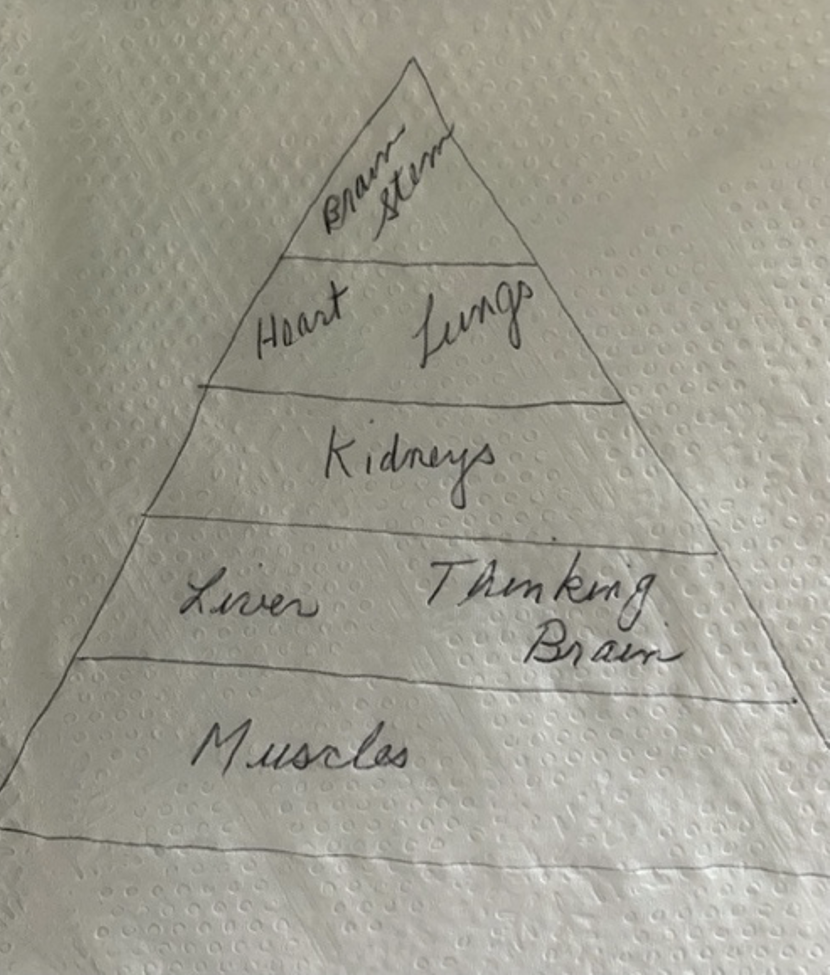
Using this diagram, I explained the function of each essential organ and the process as the body’s energy depleted due to a life-threatening disease.
The Body’s Goal for Survival:
The body has a natural shutting down process, programmed to preserve the body’s energy for the organs most important for survival, with the general goal to continue to live with the greatest comfort and as long as possible.
The Role of Each Organ:
The brainstem, at the lower back of the brain above the spinal cord, is the director of all the body’s essential functions, controlling all the other essential organs. The brainstem receives its information by analyzing the blood flowing through it. It sends orders to the organs via the blood flowing back through each organ.
The heart and lungs are second in importance. Survival of the body depends on blood with its nutrients and oxygen flowing to all parts of the body.
The kidneys are third in importance. The kidneys keep the body’s internal environment in balance (i.e., the electrolytes, sodium, potassium, etc.). The body’s internal environment must be kept within a very narrow range for the body to function efficiently. The brainstem monitors this balance and directs kidneys’ function. The kidneys also remove waste products from the body.
The digestive system and the thinking brain are fourth in importance. For the body to function efficiently, its needs energy. The digestive system fulfills that role as well as playing a vital role in removing waste products. If the body is in crisis, the brainstem, knowing the body has energy reserves, can shut down the digestive system for a short time without harming the body’s survival.
The thinking part of the brain requires energy to function and is essential for quality of life but not for the body’s survival. The brainstem increases the brain’s sleep cycle to preserve energy in a crisis.
The musculoskeletal system is on the lowest level of the hierarchy. This system is vital for quality of life but is not essential for survival. The brainstem only allows energy to be used by the musculoskeletal system when all the other more important organs have accomplished their vital functions.
The Body’s Natural Shutting Down Process
After helping the patients and families gain a basic understanding of the body’s organization, I shifted my explanation to the changes the families observe as the body progresses naturally toward death.
I emphasized that families often observe these changes, these clues, well before the professional caregivers, because they know their loved ones so much better than anyone else. They are with them more often and understand the significance of the changes in their loved one’s day-to-day life.
Musculoskeletal Level:
I started with the body still functioning at the musculoskeletal level but slowly ‘running out’ of energy. The family observes the patient’s world becoming smaller and smaller: shorter walks and more recovery time; then no outside activities; then difficulty with stairs and showers, leading to all personal care on one level. The family continues to plan celebrations but observes that only short, small gatherings are tolerated.
I call these changes warning signs. They are not life-threatening signs but signs the illness is progressing and starting to affect the body’s essential organs for survival. The brainstem, aware of the danger, starts to direct the body to preserve energy to protect the function of the essential organs. When families understand that the underlying illness is the reason for the fatigue, they can easily find ways to preserve energy while continuing to plan activities most important for their loved ones.
I emphasize that if the patient or family ignore the brainstem’s survival strategy by wasting energy on non-essential activities, the brainstem will find a way to STOP the activity quickly by producing some very distressing symptoms, such as, fainting, shortness of breath, nausea, confusion, or pain. The brainstem will not let death occur because the family or patient wishes to perform a non-essential task.
At the musculoskeletal level, there are too many factors affecting the progression of the illness to answer the question, “How long?” The body is a sophisticated ‘survival’ organism. It is incredible what it can do to continue to live when allowed to regulate its energy and maintain its inner balance. Another variable to consider is the power of the human will – never underestimate it!
Digestive and Thinking Brain Level:
The clues at this level are more significant signs of impending danger, but still not life-threatening. The family observes:
Though these signs are not life-threatening in the short term, they are warnings of a crisis in the near future. The body has energy stores that can be easily used without harming the body’s essential functions, but not for long. The answer to the question, “How long?” becomes weeks to short months.
Kidney Level:
There are very clear signs that the kidneys are failing. The family observes:
These signs warn that the disease progression is now life-threatening. The answer to the question, “How long?” is days to a few weeks.
Heart, Lungs and Brainstem:
When the brainstem has only enough energy to control the heart, lungs and itself, all three essential organs are so integrated in their functioning that the failure of one of these organs causes the other two to fail as well. Death is now imminent.
There are only a few ways families will observe that death is imminent:
I reassure families that these ways of dying are not ‘painful’, but several can cause distress. All the symptoms can be controlled when we understand and pay attention to the observations and prepare to control the distressing symptoms.
To my surprise, the first two times I provided these explanations of the body’s natural pathway toward death, the family members looked at each other, then at me and said, “This makes so much sense. Why did no one explain this progression to use before? Now we can plan our care for the future.”
I had been hesitant to explain this ‘science’ of the body’s shutting down process to patients and families because I had no definitive evidence to prove my explanation. My knowledge came from my biochemistry background and my clinical assessments of patients over the years. I knew it was the science, but I could not prove it with objective evidence. Now that I was sharing with patients and families, I hoped, at least, it would be a helpful explanation. When I returned to both these homes for the next visit, I was somewhat reassured when I observed the families and patients calm and reassured and noticed each family had carefully taped my terrible drawing on the refrigerator door. I knew from experience that anything posted on the refrigerator door is significant to the family!
I decided that this Hierarchy of the Body card, with its explanation of the body’s natural path towards death, would be a valuable teaching tool for me to use in the future. I asked my brother, who possessed impressive artistic talents, to create the teaching card for me.
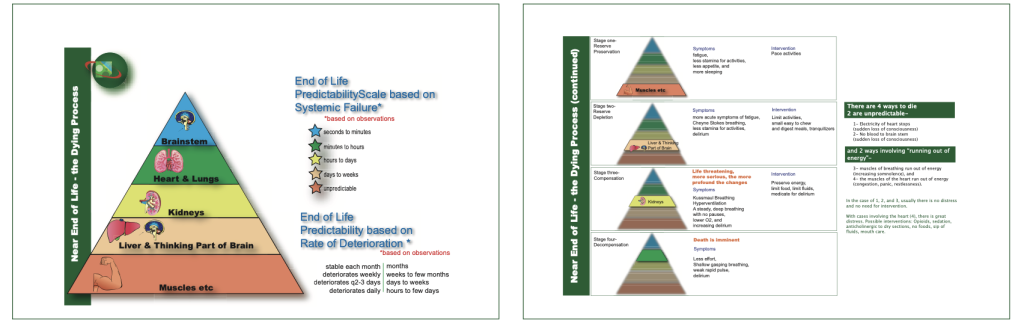
Since I created the card, it has proved useful in many circumstances as described below.
Patients Requesting Information:
When patients and families asked the questions: “How long?” “What will the process be like?” after my initial response using my card, I always left the cards with families for them to study and discuss through their journey. The knowledge gave the family confidence and a sense of control. When crises occurred, they would either say, “It happened as you said it would.” Or even better, they would report, “This is what I see happening now. Why is it different from your card?” They felt comfortable enough to challenge my knowledge as partners in the journey. We learned from each other.
Teaching Sessions:
I often used my cards during my teaching sessions and handed out a copy to each participant. They would often come to me afterwards explaining how much relieved they
felt. They knew now that their loved one’s journey had progressed precisely how it should have happened. They believed now that the care they provided for their loved ones was appropriate.
Retirement Homes:
I used my card to explain to the staff the changes that would occur to their residents. The nursing directors would place a copy of my card on the wall in the nursing offices for use in further discussions.
I have never felt I needed to change the structure of this card, but I continued to be worried. Yes, I knew it was a useful tool, but I still had not validated it through clinical data. I was very aware of this weakness in discussions with my hospital palliative care colleagues. In the future, I needed to find a way to obtain and document the scientific proof.