
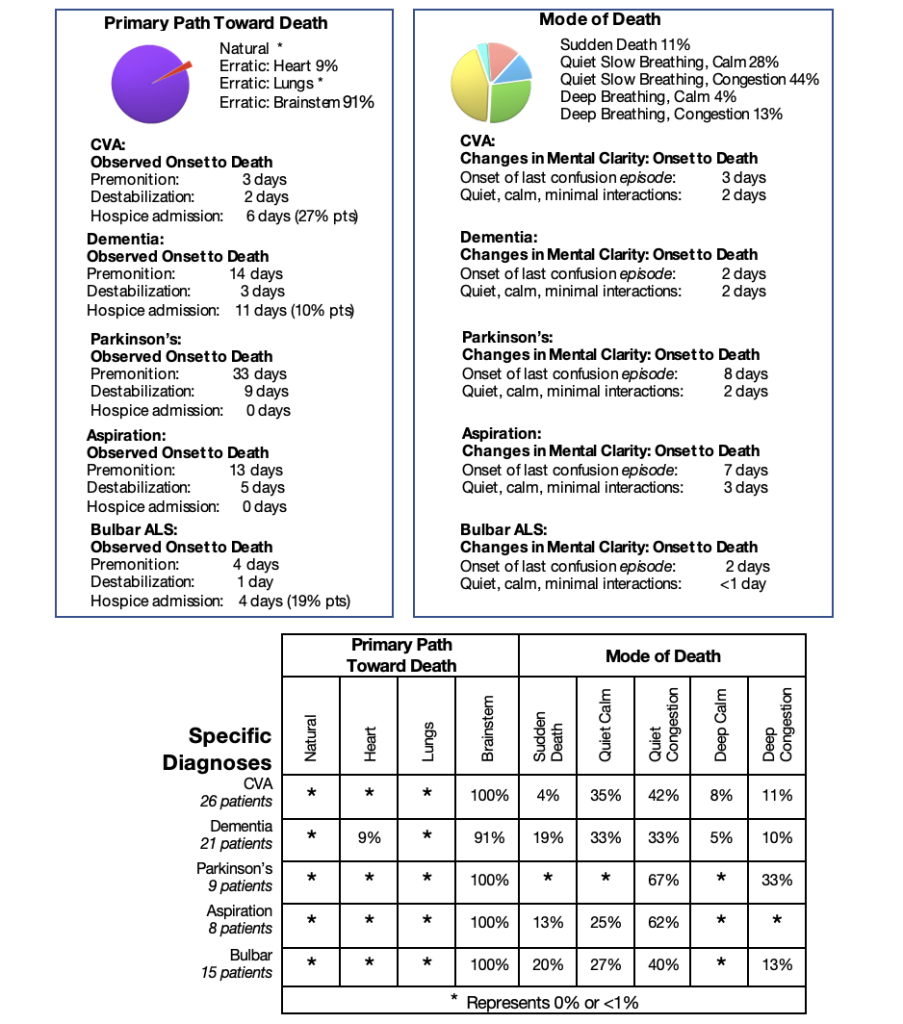
Almost all the patients diagnosed with non-cancer brainstem disease followed the body’s erratic path toward death triggered by their brainstem failure. Only one patient, diagnosed with dementia, followed the erratic path toward death triggered by heart failure due to associated heart disease.
Patients, with CVA (i.e., strokes), dementia, and aspiration pneumonia, were referred after several hospital admissions for rapid deterioration. Often no definitive underlying cause was found. Once community near-end-of-life care was initiated, none of these patients were readmitted to hospital.
For all patients requiring regular injectable medications, the regime was initiated just one to two days before death. Scopolamine, used to control congestion, was ordered in 60% of the patients, one day before death.
Although the patients diagnosed with the various specific diseases in this group followed the erratic path toward death triggered by brainstem failure, they did so at very different rates. As well each specific disease had unique symptoms in the early part of the patient’s journey that identified the origin of their life-threatening disease. The premonitions also varied in each specific disease and were unique with every patient making accurate predictions of the timeline to death very difficult. Still, once destabilization occurred, the timeline to death was often very short in all the specific diseases.
Specific Diagnosis: Strokes, Parkinson’s
Erratic Path Toward Death Brainstem Trigger
Pre-referral Information:
Joseph, 84, lived at a long-term care facility. His wife, Barbara, called and asked me to provide palliative care for him, explaining that he had suffered ‘some sort’ of life-threatening complication a few days before. The staff physicians at the long-term care institution were not sure if the episode had been aspiration pneumonia, a seizure, or a stroke. His family decided against an admission to hospital for investigations and to keep him at the long-term care facility with a palliative approach to his care. The expectation from the team at the long-term care facility and his family was that his prognosis would be very short. Over the next few days, his death appeared imminent, but then he improved a little, although still precarious, sleeping most of the time. He was eating just a little pureed food before he began to cough from residual food in his throat.
Joseph had a long, well respected career as a surgeon. Barbara was a nurse who had helped run his office for years. They had six adult children, many grandchildren, and a growing number of great-grandchildren. Joseph was devoted to his family, evident from the many photos of family reunions on the walls of his room.
Barbara continued to want the best care for him and decided to ask for a palliative care consult in case of distressing symptoms. I readily agreed to take on Joseph’s care. But Barbara had already decided I was the right person to care for her husband – so I do not think the decision was really in my hands!
Initial Contact:
My first visit was with Joseph, who was in bed in his room, Barbara, and three of their children, two of whom were practicing physicians. We reviewed the history of his illness, focusing on the timeline and the complications that had occurred. Then we focused on the immediate symptoms. Joseph had progressive dementia and Parkinson’s symptoms over the last ten years. His wife had cared for him at home, but as his behavioural dysfunction progressed, he became more aggressive with confusion. He was a tall, strong man. Barbara was petite in stature and had severe osteoarthritis of her knees, hips, low back, and shoulders. She had had two knee replacements in the past years. It came to a point in his illness when she could no longer care for him physically and monitor him continuously day and night to keep him safe from his restlessness and wandering. She finally admitted that he needed to be placed into a long-term care facility. But Barbara and her family were determined to prove to Joseph that they did not and would never abandon him. One of the children visited at noon every day to feed Joseph. Barbara visited Joseph every afternoon, supervised the supper meal and helped to feed him, taking him out in the garden in a wheelchair in the evening or just stayed with him until bedtime to help the nurses and support workers provide his evening care.
Over the years, Joseph continued to deteriorate slowly. On admission, he was able to ambulate. Just before the major crisis, he required transfers by mechanical lift to a wheelchair for meals, occasional outings, family celebrations, and weekly baths. His behaviour had improved with no further outbursts. Joseph slept well at night, and cooperated with his care, and transfers.
His deterioration had not been smooth. In listening to the story of his progressive dementia and the episode that had initiated the referral, I felt multiple strokes caused Joseph’s underlying dementia more than a slowly worsening Alzheimer’s or Parkinson’s pattern. Joseph was demonstrating an erratic path toward death with cyclical episodes of sudden deterioration followed by recovery, but never back to his previous baseline.
It appeared that Joseph was recovering a little from this latest episode. He was able to take small amounts of pureed food without choking. He did not appear to be in pain. His vital signs were normal. Perhaps Joseph would recover further or maybe he would have another life-threatening episode in the following days or weeks. We needed to prepare for either outcome.
Fusion of the Science with the Art of Near-End-of-Life Care:
First, his family and I needed to use the science of near end-of-life care to simplify Joseph’s medications and optimize his functional ability:
Parkinson’s: Joseph was on Sinemet for his Parkinson’s. At some point, he would not be able to take oral medications. For now, he could tolerate a few tablets crushed in apple sauce. I suggested changing the Sinemet to a lower dose at mealtime only and monitoring if his stiffness increased, interfering with his personal care and increasing his discomfort.
CVA (strokes): I then suggested lowering his blood thinner dose by half giving some coverage for a stroke, but a low enough dose to avoid the need to draw blood weekly for blood levels and to lower the risk of a severe bleed.
Pemphigoid: Joseph suffered from bouts of pemphigoid expressed by large blisters on his limbs and genitals, causing discomfort. He had been given several courses of Prednisone in the past with initial high doses, then tapering, but the blisters would soon recur. I suggested a dose of Prednisone at the lowest level that would not cause agitation nor increase his appetite for food.
Destabilization Medications: After his last episode, Joseph had been prescribed small doses of Hydromorphone, Midazolam and Scopolamine as needed but injectable medications had been needed. I left the orders without any changes, at least for the first few weeks, in preparation for a new sudden crisis.
Aspiration Pneumonia: My last topic of discussion was the most delicate. We needed to reduce the danger of aspiration. This discussion required an understanding of the science of the body’s essential functions combined with the art of care in these unique circumstances. Joseph’s family was very dedicated, all wanting the very best for him. Joseph had always loved to eat. Feeding and spending a little quality time with Joseph each day was central to the family’s sense of really caring for him. I explained that they needed to continue feeding Joseph as they had in the past, but now they needed to observe the signs of when they should stop. They were the experts. They knew when Joseph no longer wished to eat or could not swallow well. Barbara had already described many of these signs. Some days he would take longer than one hour to eat a meal.
He would tire and pocket food in his mouth or he would not open his mouth and would constantly need to be reminded to swallow. Barbara knew the most ominous signs were a cough or burp with each bite. I explained that the danger of aspiration increased exponentially when he demonstrated these signs.
I suggested that when the family observed these signs, they could substitute ice cream which Joseph loved. If he refused, we would know he was not able to swallow. If he did eat the ice cream, the family would have achieved two goals for Joseph, including nourishment for his body’s needs and an easy technique to clean up the debris of food in his mouth. Everyone understood the rationale conceptually, but feeding is ‘heartfelt’. It would be difficult to stick to this plan day after day, especially if Joseph improved and remained stable for a few weeks and months. The need for caution would start to wane, everyone would forget just how precarious Joseph’s condition was, and more risks would be taken.
Second, before ending my first visit, I asked the family if they had any questions. Barbara had one wish for herself and Joseph. She stated, “If we can predict at some point that Joseph has just a few days to live, I want to bring him back home and care for him in our own home until he dies.” Her children were unsure if it was a good idea, but they agreed to defer to their mother.
At the end of the first family meeting, we appeared in close agreement, all the family members agreeing to the changes we had made. Time would tell how the plan worked for Joseph. I decided to visit twice a week for the first few months, always at the time of the supper meal. I knew Barbara would always be there. She was in control of the care of her husband and had a daily update from her children visiting for the noon meal.
Episodes:
Joseph did amazingly well for the first few months. He continued his usual daily routine with no major crises. Then, suddenly, he demonstrated subtle signs of a minor stroke. His family understood the significance and knew what to do. They mobilized, keeping Joseph in bed for a day, and offering a little soft food but stopped quickly if he started to choke. He settled within a few days, returning to his usual routine. I reduced my visits to every two weeks knowing that Barbara would call when she needed me between visits.
Over the next three months, Joseph did not have significant episodes, only occasional fevers with no other symptoms tolerating only two meals in the day needing to start his bedtime personal care sooner because he would fall asleep in the chair.
He continued to sleep very well at night. As usual, his family planned a Christmas celebration at the residence. Joseph participated, and to everyone’s surprise and joy, he held his great-granddaughter and smiled radiantly at her.
The following nine months, Joseph’s care was well managed by the family. The routine continued with all family members responding to any premonition signs. By preventing the major complications, we observed more clearly the small changes in Joseph’s functional ability. He tolerated being up in his chair only for meals, opening his eyes less and less frequently. He nourished and hydrated himself but was more inconsistent in his eating from one to three meals in a day. Joseph’s clear premonition that he could not tolerate any more food was evident to everyone when he began to burp. Each family member stopped the meal. Occasionally, he would accept a little ice cream.
Six months before his death, Joseph had another obvious minor stroke. He recovered within one day, but we could now see weakness in his left arm and left face. His functional level continued to decrease. He was missing more meals due to swallowing problems, with the feeding plan, he did not aspirate. Whenever he started to cough, he usually enjoyed a little ice cream.
Four months before his death, his daughter found him slumped over in his chair at noon. Joseph remained unresponsive for most of the day. A week later, he had a bout of congestion that cleared spontaneously. For the rest of the next month, he remained in bed for his evening meal. His wife tried the pureed food, but he enjoyed and swallowed better when eating ice cream.
One month before his death, Barbara organized a family Christmas celebration and to everyone’s surprise and enjoyment, Joseph rose to the occasion again. He opened his eyes, appeared to focus and enjoy his family, and ate some of the soft food without any coughing.
Destabilization:
Three weeks before his death, Joseph suffered another stroke. His oxygen saturation fell to 90% and his respiratory rate increased to 24, both for the first time. He recovered but could no longer tolerate transfers out of bed and could only handle a little ice cream twice a day. These were the first signs of destabilization.
I started to visit daily. This was the destabilizing moment I had anticipated. If Barbara and her family still wished to transfer Joseph home for his death, we would need to decide soon.
In the past, he had improved, but with the change in his vital signs, Joseph was now more precarious. He did recover enough the next day to enjoy a little of his birthday cake with ice cream. But with that effort, he slipped again, and it was apparent that he only had a few days to live. His respiratory rate was 28 and his oxygen saturation was 80%.
Death Imminent:
I explained to Barbara that, if she had not changed her mind, now was the time to transfer Joseph home. Barbara was more than ready and her children agreed and mobilized, organizing a hospital bed in their house and an ambulance to transfer Joseph home the next day. I stopped all his oral medications. Before transfer, to ensure comfort, I gave one vial of Scopolamine subcutaneously. He tolerated the transfer very well. His breathing was now a deep Central pattern, his oxygen saturation was 84%.
Joseph’s family had experience in administering injectable medications, so I started Phenobarbital at bedtime to replace his Parkinson’s medication. I ordered Midazolam a half vial and Scopolamine one vial every four hours as needed for comfort. Although he did not have congestion yet, congestion could start rapidly with his deterioration following an erratic path toward death triggered by brainstem failure.
Joseph’s first night was very quiet. Barbara slept beside him. The next morning, he remained calm and comfortable all day with his family surrounding him with his respirations increasing to 44 and oxygen saturation now to 74. He died quietly in the evening with his family beside him.
Timeline To Death
Predicted: Short weeks Actual: 18 months
Joseph was a wonderful man, well respected in his career and well-loved by his family. Unfortunately, he suffered an illness that progressively took away his cognitive abilities. Barbara wanted to care for him at home until his death, but circumstances beyond her control made it impossible for her to do so. It was such an agonizing decision for his wife and family to transfer Joseph to a long-term care facility, but the reality left no other option.
Once Barbara accepted Joseph’s transfer, she worked tirelessly to make Joseph’s room in the facility ‘his home’. The family mobilized, ensuring all of Joseph’s needs were met and he remained a part of the family celebrations. He rewarded them with the occasional look into their eyes and occasional smiles.
As a bonus, Barbara did what she did best. She observed, and became an advocate for the patients, families, and staff on Joseph’s floor at the institution.
Joseph’s progression was typical of patients with multi-infarct dementia at near end-of-life. Symptom control with medications was easy. The first step was simplifying and adjusting the regime. I did not make any further changes for a year and a half. But I was prepared with injectable Midazolam, Phenobarb and Scopolamine in case of rapid deterioration.
The most significant intervention to help patients with recurring strokes and aspiration pneumonia by nurses, physicians, caregivers and family is to set up a feeding regime acceptable to the patient who still wants to eat, and to the family members who feel that feeding is the most nurturing act they can do to demonstrate their love for the patient. The regime must balance the desire to eat with the ability to eat in order to minimize a life-threatening aspiration pneumonia.
Joseph’s family was so loving. They so wanted to feed Joseph, knowing that he loved to eat! But they also wanted his best comfort and longest life possible. When the family understood what to look for indicating impending aspiration, they became the experts at the bedside, reducing the feeds until recovery. With no severe aspiration, the symptoms of the underlying stroke ‘episodes’ became more evident. His family was surprised that with no pneumonia, and despite less nutrition, even though Joseph continued to have recurrent small strokes, he recovered repeatedly and followed a longer and much more comfortable path towards death. His prognosis increased from the predicted ‘few days’ to ‘eighteen months’, filled with many family celebrations and intimate moments during the time spent feeding and interacting with him.
At the very end, Joseph gave Barbara and his family the greatest gift. He gave them a warning that the end was near and continued to fight until he was safely at home with all his loving family. Barbara was sleeping beside him and holding his hand when he died.
Specific Diagnosis: Parkinson’s, Recurrent CVA
Erratic Path Toward Death Brainstem Trigger
Pre-referral Information:
I was asked to provide care for Frances when she returned home after her third hospitalization in two months. Frances, 81, lived in an apartment with her husband, who also had physical limitations. She had a daughter who lived and worked overseas with her two children. Her daughter tried to visit her parents as often as possible and staying several weeks at a time. France’s niece, who dearly loved her aunt, lived in the city. Her role included organizing the caregivers and ensuring her aunt and uncle had the necessary care.
Initial Contact:
We set up my first visit to the home with Frances, her husband, daughter, niece, the visiting nurse, and the personal care worker. Frances was in bed, alert, able to answer a few questions and cooperative with repositioning. Her daughter and niece provided all the details of her history and symptoms. Frances had been diagnosed with Parkinson’s disease 16 years before. She also had chronic lung disease, further complicating her health.
France’s physical symptoms from her Parkinson’s had progressed slowly over the years, but in the last year, she had more and more difficulty with ambulation and transfers. At times she suffered distressing ‘freeze’ episodes (her whole body would become rigid) preventing easy transfer to a chair or bed even with help. Her recent admissions to the hospital were triggered by progressively more severe episodes of aspiration pneumonia and atypical seizures. During her last hospitalization, Frances had been given antibiotics for pneumonia, but her niece felt she had improved before the antibiotics would have had a chance to be effective. The attending team investigated and noted difficulty swallowing, leading to aspiration of food into her lungs. The team concluded there would be no benefit of returning to the hospital, referring the family to community palliative care. They felt she would die within a few weeks, likely due to aspiration pneumonia.
Frances did not believe such a bleak prognosis. She was pleased to be back home where she would get better and continue to eat real food. Her ultimate goal was to transfer to her wheelchair every day and enjoy her life with trips out of her home for shopping and meals at restaurants. She did live – for just over a year!
Fusion of the Science with the Art of Near-End-Of-Care:
To stabilize Frances’ condition, both mentation and functional ability, we had to address a combination of difficult symptoms and issues to control – all interrelated.
Nutrition: Frances likely had recurrent aspiration pneumonia due to her bulbar muscles weakened by her Parkinson’s. The family was given contradicting advice. The hospital physicians advised to increase her feeds to gain weight. Her neurologist knew that Frances, with weakened swallowing muscles, would not gain weight and advised small amounts of soft foods for comfort. Her family chose to encourage Frances to eat as much as possible. Frances would have nothing to do with soft food. She wanted real food, sitting up at the table like any healthy person! Somehow, we had to find a solution acceptable to Frances. Fortunately, her vital signs were not precarious with an oxygen saturation of 88% on low supplemental oxygen, so we had time to find the elegant solution.
Skin Issues: As a side effect of her course of antibiotics during the last hospital admission, Frances was infected with C. Difficile causing severe diarrhea. Though the infection was mostly controlled, the diarrhea had caused severe burning of her perineal skin, a pressure sore on her coccyx and extensive ulcers on her buttocks. She had an air mattress to help with the pressure sore, but neither the nurses nor the family knew how to treat the skin irritation.
Parkinson’s: Frances was taking Levodopa six times daily, a complicated regime set up to minimize her ‘freeze’ episodes. We needed to simplify this regime.
Confusion, Restlessness: These symptoms were not new. Frances had used a very effective combination of regular sleeping medications, Amitriptyline and Temazepam, through the last year. In the hospital, these medications were substituted for a less ‘addictive’ medication. Her niece reported that Frances, now, could not sleep and, much worse, she was flailing her arms and legs throughout the night, hitting the bedrails, and leading to severe bruising over all her limbs.
In discussion with the family, we devised a short-term plan with the aim to make her environment at home safe while addressing the symptoms as simply as possible. For a few weeks, we asked Frances to stay in bed to preserve her energy, control her symptoms, heal her skin, and reduce her bruising. For her skin problems, we simply combined a barrier cream with an antifungal cream mixed into a jar of petroleum jelly, applied liberally onto her skin and the inner layer of the diaper. To help her restlessness, we returned to her very effective pre-hospitalization regime of Temazepam and Amitriptyline at bedtime. Frances and her family were pleased to do so. She needed to rest well at night to preserve enough energy to be alert and wakeful in the day to nourish herself without aspirating. If her husband’s sleep were constantly interrupted, he would not cope with her care when he was alone with her most evenings and nights.
Most of my first visit was spent explaining to the family the significance of what they were observing using my Hierarchy of the Body card. I superimposed the effects of Frances’ Parkinson’s and minor strokes/atypical seizures onto the body’s natural path toward death explaining that her brainstem was being compromised causing difficulty swallowing, leading to aspiration of food into her lungs and pneumonia. Presently, the aspiration of food into her lungs was ‘the life-threatening’ complication of her illness.
We discussed her need for soft food. To be successful in eating, Frances needed to be awake, rested and focused on the task to swallow. Her mealtime needed to be limited to 20 minutes. Any longer, she would be too tired to ‘swallow’ properly. At the end of the meal, the caregivers needed to ensure no food was left in her mouth.
I also discussed Frances’ and her family’s care goals regarding DNR. Frances and her family had not yet agreed to DNR. Her condition was so precarious that even minor complications could be life-threatening. If she wished resuscitation, I would be forced to advise transfer to the hospital immediately for treatment. The family agreed to think about signing the DNR, but no decision was made during my first visit.
Within a week, Frances no longer had diarrhea and her skin wounds were much better. She was eating well tolerating regular, but soft food, with very little choking or coughing. Her oxygen saturation was 85% on room air. She did not appear or feel short of breath, often stating that she hated the supplemental oxygen required to bring her oxygen saturation to normal levels.
Within a month we started to have success controlling her restless legs with severe rigidity that caused discomfort and made repositioning during personal care very difficult. Although she was sleeping better at night, she still had restless movements with some hallucinations. We decided to try a small dose of Phenobarbital at bedtime and changed the regime of her Parkinson’s medication to mealtime only. By the end of the first month, Frances had good nights.
By the second month, Frances was eating soft foods well. Now, Frances wanted more. She wanted to go out to restaurants and eat normal foods. She wanted to be in her wheelchair most of the afternoon. Frances became agitated every afternoon if she was not allowed to be up, but she became more agitated in the evenings if she did sit up. The good news was that her oxygen saturations were greater than 90% without oxygen while sitting, so we were able to stop the supplemental oxygen. To fulfill France’s goals, we made straightforward and tiny changes, decreasing her Parkinson’s medication, and doubling her tranquillizers at bedtime. That was the magic recipe!
For the next three months, Frances remained amazingly stable and improved to a better functional level. She ate regular foods and slept well with fewer abnormal movements. She slept most of the morning after personal care. In the afternoon and evening, she had some excellent short lucid periods. But, with the effort, she often drifted off into ‘her own world’. She could transfer to the wheelchair with one person’s help and was out for wheelchair rides every day. Once a week, her niece would take her to a restaurant for a real meal.
Over the next six months Frances continued to have very good moments, but her caregivers and family noticed changes that demonstrated her fragility. She had episodes of increased weakness, confusion, and agitation, especially in the afternoon. Rides outdoors in the wheelchair were no longer possible. We added a small amount of Temazepam and Amitriptyline in the afternoon. She slept more but was more lucid when awake, enjoying quiet evenings watching TV with her husband. Approaching Christmas, we observed further signs of weakening including less energy with oxygen saturations often around 85%. Frances recognized her fatigue, asking to go to bed earlier in the evening. She coughed more when eating, but that did not deter her from asking for regular foods. Her nights remained excellent. She was well enough to go to the Christmas celebration at her niece’s home and did very well throughout the evening. She was exhausted the next few days, as expected, but remained comfortable.
More ominously, during one visit, I observed an episode of severe difficulty with swallowing regular food, causing cough spasms. I asked Frances if she liked ice cream. Her reaction was priceless – Frances simply loved ice cream! We stopped the meal and presented Frances variety of ice cream flavours. And just like that, we had the solution to her eating problem when she was tired! Whenever she started to cough while eating, the caregivers stopped the meal and served ice cream. Frances never fussed with the solution and her coughing remained well controlled for months. During that period her daughter visited with her children. She rose to the occasion, had terrific days while maintaining good sleep at night, with afternoon naps to enjoy evenings in her chair watching TV and occasionally going out to a restaurant. She was able to enjoy a Valentine Day’s family celebration with no significant consequences.
Life-Threatening Premonition:
Three months before Frances’ death, she appeared to have suffered a stroke. Her husband could not awaken her. Because she had been so well in the last few months, he panicked and called 911. The family, still, had not signed the DNR, so the paramedics transferred Frances to the hospital. She awakened in the emergency room, recovered to her usual self. Her niece called me. We took a moment of reflection after reviewing Frances’ condition. This episode was similar to those Frances had suffered over the last year, without the added aspiration pneumonia to complicate our observations.
I explained Frances had been so well through the year because she was home with great care, but we all knew she would eventually die from one of the episodes. The family discussed their goals and care options and decided to sign the DNR and bring Frances home without admission. They did not want Frances to die in the hospital. They would continue to care for her at home. Again, Frances recovered well.
Within a week, she was back to trips to the mall and weekly restaurant meal. But over the next two months, she became obviously weaker again. Although Frances did very well through her birthday and wedding anniversary celebrations in the apartment, she required more time to recover after each event. She coughed more with meals, often requiring ice cream as a substitute for her meals. Frances was still able to continue her outings, insisting that she was well enough to go out. The day before her final crisis, she went out to the shopping mall and back home in her wheelchair pushed by her caregiver, using the regular Ottawa bus system. She was exhausted afterward but proud of her achievement.
Destabilization:
One week before her death, Frances’ had another episode and this time, it led to destabilization. All of Frances’ previous major crises had occurred suddenly. This episode was a little different. Frances had a good night. The following day she developed a fever and a persistent cough. Her pulse was 88, but her oxygen saturation was only 83%. She had an occasional cough during my visit. Frances understood the conversation and agreed to stay in bed in the evening and perhaps the next day until we determined the severity of her symptoms. She also agreed to only ice cream for the next twenty four hours. I hoped she had developed mild pneumonia from aspiration and that it would clear spontaneously. Still, I was apprehensive this episode might be life-threatening. Our approach worked. Frances did settle, remaining comfortable though weaker. Of course, she started asking to go back to her normal routine.
Three days before her death, another episode occurred. While eating in the morning, she started to cough. It lasted for two hours, with her oxygen saturation decreasing as low as 50%. When I arrived, she had settled a little with her oxygen saturation back to the 80s, but her breathing was very laboured and irregular. Frances awakened enough to recognize her caregivers and family, then fell back asleep. To give her the best chance for recovery, she needed to rest for the day. I gave injections of Scopolamine to help her secretions and Nozinan to help her sleep. I held her oral medications and ice cream.
When I visited again in the evening, Frances, who had remained asleep in the interim, began to awaken. She said a few mumbled words, but quickly, her breathing pattern became inefficient with a gasping pattern. I explained to the family that, likely, she had suffered a brainstem stroke and, this time, she would not recover. She could not tolerate the effort of being awake, even for a few minutes. We their permission, I doubled her nightly Phenobarbital. If needed, the family could administer one or two doses of Nozinan and Scopolamine overnight to maintain her comfort.
Frances had a good night, but as the Nozinan and Scopolamine wore off, she became more awake and struggled with laboured, irregular breathing, and moderate congestion.
When I arrived in the morning, her pulse was 90, respirations over 30, with an oxygen saturation of 82%. She had copious secretions in her mouth and throat.
Death Imminent:
I was certain Frances’s death was imminent within the next hours to a few days. Therefore, I felt I needed to repeat my discussion of the science and the art of near end-of-life care one more time for the family. When death is imminent, the reality of death is very real, emotions are swirling while decisions need to be made. Therefore, these decisions involved both the ‘reality’ of what was happening and the unique ‘emotions’ of the family facing the situation.
In the discussion with Frances’ daughter, niece, and husband, everyone wanted comfort above all. We continued the Nozinan, Hydromorphone, and Scopolamine regularly every four hours to control pain, congestion, and restlessness. We requested shift nursing for the night, but no nurses were available. France’s niece took the responsibility of administering the injectable medications, but she was worried about giving too much medication, so she chose not to administer medications when Frances remained quiet.
In the morning, as Frances deteriorated further, she became restless and appeared uncomfortable with a feeble pulse. We discussed the need to give the Nozinan, Scopolamine and Hydromorphone regularly every four hours until my visit in the evening. During my evening visit, I could not measure Frances’ oxygen saturation; her pulse was feeble; and she appeared dusky but very comfortable. A shift nurse was available for the night, so the family was relieved of responsibility for the administration of medications. They could return to the role of being Frances’ family. She remained very peaceful and died in the early morning hours.
Timeline To Death
Predicted: Few weeks Actual: 18 months
Frances was a powerful woman who needed to control the situation even when her physical abilities were limited. She liked to be well dressed, to eat well and be social. Through her progressive illness, the family’s goal was to optimize her comfort in a way that would allow her to achieve as much quality in her life as possible.
It was difficult to dress her, then transfer her to the wheelchair to go out for walks. It was even more difficult to transfer her into a car, lift her wheelchair into the back of the car and get her into a restaurant or to her niece’s home for a family celebration. But the family did so for her, and they succeeded so well. Frances so loved these excursions! When Frances could no longer go out of the apartment, she had beautiful quiet evenings with her husband, usually watching an old movie. She loved her ice cream when she could no longer eat her ‘normal’ food.
Frances’ death did not come from overextending herself physically. It did not come from aspiration of her food. Death came upon her quickly from a severe stroke over which she had no control. After all the efforts, her family was given a gift – she died swiftly with dignity in her own bed with her family close by.
France’s journey is unique but is similar in many ways for families caring for someone dying of a brainstem disorder. It is very difficult for families caring for patients at the near-end-of life when the thinking process needs to encompass several very different possibilities. In Frances’ case, the family had been told she had days to live. After a few weeks at home, it appeared she might have months or a few years to live if she did not aspirate, causing pneumonia. But as well, she could suddenly have another life-threatening stroke and die very quickly. All these possibilities had to be considered in the care plan and discussed with the family frequently.
It is only human to adapt to the current path forgetting the others, only to face a crisis without any plan in place. Frances had been stable for many months, so the family was lulled into a sense of normalcy, only to be faced suddenly with an unconscious patient. There was no plan in place, so her husband panicked, called 911, and she was whisked to the hospital. After a few hours, the family rethought the process of Frances’ illness and brought her back home as they had initially decided, with a much clearer understanding of the reality of her condition.
Specific Diagnosis: Bulbar ALS
Erratic Path Toward Death Brainstem Trigger
Pre-referral Information:
Janet, 84 years old, was diagnosed with Bulbar ALS and followed by the ALS clinic. Three months later, she and her husband asked to be referred for community palliative care. Janet and her very supportive husband John lived in an apartment. They had three adult children, two of whom lived in Ottawa, also very involved in her care.
Initial Contact:
At my first visit with Janet and her husband at their apartment, Janet fully participated in the interview. On reviewing her history, both felt her symptoms had started about a year before diagnosis. They had observed Janet stooping over while walking, her hands becoming stiffer and weaker, and her voice was softer with slurring of her words. She was an avid swimmer but had to stop due to weakness and shortness of breath. At her last assessment at the ALS clinic, her speech was obviously more slurred but fully intelligible in a quiet environment. She still had the dexterity to type, so she could communicate well. Janet could chew and swallow a regular diet, occasionally choking on liquids and saliva, but it took more time to eat, and she tired quickly. She always had difficulty taking medications, but now, she had even more difficulty. She was able to walk on one level using a walker most of the time.
Both Janet and her husband understood the significance of the diagnosis and had discussed the approach to Janet’s care. They decided that they would not agree to ‘heroic’ measures when she progressed, and both wished to continue all Janet’s care at home. As I observed them expressing their clear decision, I felt that they were deciding with their brain, logically, being very careful not to let their emotions play a role in the decision. Janet and her husband were coping well. Janet managed all her essential activities of daily living, and her vital signs were normal. They told me not to visit regularly, stating they would call me if they needed help.
Fusion of the Science with the Art of Near-End-Of-Care:
Two months later, Janet’s husband contacted me, asking for a visit mainly to keep our link open. Janet was doing well, but all activities were taking more effort. On review, she reported signs of progression, all non-life-threatening. Her vital signs remained normal, and she still managed her essential daily activities independently.
Some of the signs were lower motor neuron expressions of her ALS. Her legs were weaker, requiring her to use the walker all the time. Janet used a soft collar to hold her head up when she was tired and during excursions out of her home. She admitted she was going out less and sleeping more. She had restarted to swim very slowly and only for short periods.
Some of the signs were bulbar expressions of her ALS. Her main frustration was that she could no longer chew fibrous foods, although she could still eat her supper well slowly. At this point, my only advice was to continue to pace her activities as her body already forced her to do. They asked me to visit regularly every two months.
Six months before her death, Janet demonstrated more serious expressions of progression. Still, her vital signs remained stable. It appeared that the bulbar expressions were changing more quickly. Janet had more difficulty swallowing, and now her food was mainly blended. She had more difficulty speaking, but family understood her when she spoke slowly. The lower motor neuron signs were also progressing, but not as quickly, demonstrated by more weakness in her legs and hands. She was still managing to swim, now only a few times a week. Janet had agreed to the help of a personal care worker, which she enjoyed, helping her to preserve energy for recreational activities and family visits. Janet and John were a little more anxious, so they were pleased with the security of regular physician visits.
Decision-Making During the Near-End-Of-Life Journey:
Five months before her death, Janet started to demonstrate most obvious premonition signs indicating her disease was starting to interfere with her essential daily activities. These signs caused Janet and her husband to revisit their decisions made soon after her diagnosis regarding active interventions to extend her life. They scheduled an ALS clinic appointment to discuss the benefits of a BiPAP machine to help with her breathing. They agreed to a trial of the BiPAP machine four hours each night with a tranquilizer to help her sleep. Then, they reconsidered the insertion of a gastric tube to ensure she had optimal nutrition to maintain her strength. Janet’s swallowing was much more difficult. Still, she could manage soft meals with effort and concentration. Within a few weeks, the gastric tube was inserted, and they began experimenting with the tube feeds.
I often observed this trend in decision-making through the near-end-of-life journey. When experiencing frightening symptoms as they approach death, patients and families start to make decisions with their emotions intertwined with their logic – decisions with their heart. These decisions may be very different from the initial logic ones.
In Janet and John’s situation, upon diagnosis, they were sure of their decision to let the disease take its course without intervention except for supportive care and medications for symptoms. But when Janet was confronted with difficulty breathing, it was indeed frightening, so she considered using a BiPAP machine. Now that Janet’s swallowing was more of a challenge and the choking was more frequent, they thought nutrition through a gastric tube would be a good option, since Janet did not feel she was dying, and she needed nutrition to have the energy to do her essential and recreational activities. The reality was that the swallowing problem was a symptom of the brainstem losing control over the swallowing muscles. Taking nutrients through a gastric tube would not improve the brainstem problem and prolong her functional ability. But she had to try – she wanted to live!
Over the next three months, Janet adapted to her new interventions but her breathing and swallowing muscles continued to weaken. Her vital signs remained stable. She was apprehensive with her BiPAP at night, especially when there was moisture in the tubing. She had difficult achieving an adequate seal and developed pressure areas on her face from the BiPAP mask. We discussed the use of Midazolam to help calm her. Her husband had medical expertise and no fear of giving a subcutaneous injection. This solution was only partially effective. When Janet was sleeping, she had a feeling of pressure on her chest. Her husband could not achieve an appropriate seal on the BiPAP, so it was not really helping her to breath. But, for some reason, Janet LIKED it. It made her feel secure. She had minimal problems breathing well on her own during the day. Together, we found the elegant solution. I suggested a hospital bed, raising the head of the bed to thirty degrees to partially relieve pressure from gravity on her chest while she was sleeping. Two weeks later she no longer needed the BiPAP and never restarted it.
Janet did not tolerate her gastric tube feeds well, accumulating uncomfortable phlegm in her throat. When she diluted her feed by half, she did much better. I suggested reducing the volume of gastric feeds by one-half and ordered a suction machine for her oral secretions. She also had Atropine drops to help dry the secretions. With these minor adjustments, Janet started to tolerate her gastric feeds. With the suction machine, she cleared her oral secretions by herself. She knew she had control of her feeding regime now, and she felt able to solve some of her own problems.
Her communication was more difficult, but she had been assessed at the ALS clinic for a computerized communication board since she could still type with weakened hand muscles. Janet could now communicate well with her new device when she was too tired to speak. Her ambulation was more limited, so she agreed to and enjoyed an electric wheelchair.
Two months before her death Janet’s functional ability was stable. But occasionally, she became very anxious during the night, requiring Midazolam more frequently to calm her. She also admitted to more difficulty with transfers needing the help of one person for all her transfers to prevent falls. I was concerned about the awakening and anxiety at night, even though she tolerated the Midazolam injections, and they were effective. In discussion with Janet and her husband, we decided on a more practical solution. We started to administer the Midazolam by pump subcutaneously, with a tiny dose continuously and as well as an emergency dose as needed. Janet and her husband were very pleased with the benefits.
One month before Janet’s death, her usual problems of secretions and anxiety were now well controlled with the Midazolam pump and the suctioning. She was still communicating verbally and with her computer and walking just a little. Her vital signs were normal after a walk.
Life-Threatening Premonition:
Two weeks before her death, Janet became more anxious requiring frequent Midazolam boluses up to eleven in the day, mostly at night and after transfers. She was eating about the same, still trying to be active. She was now requiring suctioning twice daily. For the first time, her oxygen saturations were affected by the stress of any activity, falling to 88% for a few minutes. I felt we were at the beginning of the destabilization. She started to follow the erratic path toward death triggered by brainstem failure – the bulbar expression of her ALS. In this type of ALS, I knew that once the brainstem had difficulty maintaining the essential breathing function in the night destabilization was very rapid.
One week before her death, Janet’s husband, daughter, and son-in-law reported that Janet had less energy, was sleeping longer, requiring two naps in the day. She was sleeping better at night with a tablet of Lorazepam rather than a Midazolam dose. She was still trying to ambulate, but her oxygen saturation fell to 91% after a short walk. She needed to have all her personal care in bed. Even though she had less mucus in her throat, at rest, she had more difficulty breathing.
Destabilization:
One day before Janet’s death, I was called urgently by the visiting nurse. Janet had significantly deteriorated. She was sleeping most of the time but was still taking gastric tube feeds. Her oxygen saturation was in the low 80s all the time. When I arrived, she was in bed asleep with a pulse of 100. I observed increased work of breathing with a Cheyne Stokes pattern, the non-breathing phase lasting ten seconds, and respiratory rate 40. These findings were objective evidence of destabilization. I explained my observations and concerns to Janet and her husband. We decided to stop the gastric feeds, and give a little clear fluid, providing mouth care for comfort. We made no changes to her Lorazepam and Midazolam, but I ensured there was Scopolamine in the home in case of need. I requested continuous nursing shifts. By the evening, the nursing care was in place. Janet was restless despite three Midazolam boluses with an oxygen saturation at 82%. I advised Scopolamine subcutaneously and then every four hours if needed and doubled the continuous dose of Midazolam to reduce the need for frequent intermittent doses.
Death Imminent:
On the day of Janet’s death, I visited with her family with the shift nurse present. Janet had a quiet night needing Scopolamine only once. In the morning, she was peaceful but struggled at times, settling with four boluses of Midazolam. She was dusky, breathing with a variant of a Cheyne Stokes pattern. Her breathing rate was 44, but shallow with almost no air movement. At the deeper breaths, she was struggling a little. I felt she would die within a few hours. She always ‘liked’ the calmness she felt when she used the Lorazepam tablet, so I decided to give one dissolved tablet through the gastric every four hours regularly. I knew it would likely not be absorbed, but she did like her Lorazepam! She only had one dose, then Janet settled and died quietly with her family around her a few hours later.
Timeline To Death
Predicted: Unknown Actual: 18 months
Patients with bulbar ALS differ in their progression from patients with the brainstem strokes, usually deteriorating more rapidly and with fewer crises and recoveries. They usually maintain their cognitive abilities until they ‘destabilize’ but have difficulty communicating their thoughts due to weak speech muscles.
They do NOT feel they are close to dying until they ‘destabilize’ and are very reluctant to take any medications that interfere with their cognitive clarity. When they weaken, as with Janet, they start looking for interventions like the BiPAP and gastric tube feedings to extend their lives. The reality is that when they are following the ‘erratic’ path toward death triggered by brainstem failure, extra feeds and BiPAP rarely improve their condition and can increase their discomfort.
Janet’s progression toward death was easy to follow, demonstrated by weakening of her bulbar muscles, leading rapidly to ‘brainstem’ dysfunction. But we also observed weakening of her peripheral muscles caused by lower motor neurons, leading to difficulty with ambulation and a heavy sensation on her chest, making breathing difficult while lying flat. It is common for patients with ALS to have both lower motor neurons and the bulbar upper motor neurons affected. As the disease progresses, it becomes evident which neurons fail first, triggering the ‘erratic path’ toward death from ‘brainstem’ or ‘lung’ failure.
My experiences with patients with ALS, who remain lucid until very close to their deaths, believing that they are NOT dying until a few days before their death, challenged me to take a very different approach to decision-making at near-end-of-life. They forced me to understand, and revisit, all major decisions at every significant crisis, especially the DNR order throughout their near-end-of-life journey. Especially, we as professionals think that once a DNR order has been signed and placed on a patient’s chart, it is now ‘written in stone’. The reality is that patients have a right to change their minds. It is essential to ask these questions early when the patient is facing death in months to years, but, also, revisit the decision when death is right in front of them. The emotions involved in the later decision may lead to a very different outcome.
Of note, there is a third type of ALS, a rare form, called Primary ALS. It originates from the same disease but is expressed in different areas from the other types of ALS. This disease tends to progress more slowly. Its primary expression sites are the upper motor neurons, leading to a variety of symptoms, including balance issues, muscle spasticity causing lower back and leg pain, rather than the severe weakness of patients with respiratory ALS. Speech impairment and swallowing issues occur but are not as debilitating as patients with bulbar ALS. Respiratory problems are common late in the illness, most often observed during the night. It is a form of ALS, with its varied, complicated, and often vague symptoms waxing and waning, that is often misunderstood leading to difficulties in implementing the appropriate care plan for the patients and their families.